



When the work of being seen becomes more important than the comfort of staying hidden
Inge van de Graaf lives above a bar. Not near one—above one. The ground floor of her home is De Amer, a cultural cafe and music venue with velvet curtains, a fully stocked bar, and decades of history. For a woman navigating sobriety, this might sound like an impossible setup. But for Inge, a trauma therapist and medicine woman from the Netherlands, it became the perfect teacher.
Inge spent most of her life terrified of being seen. She named her practice after a tree because it felt safer than using her own name. She called herself a regression therapist because it was explainable, professional, contained. But the work she actually does goes far deeper—guiding people across thresholds from conscious problems to unconscious origins, from who they think they should be to who they actually are. When she finally stepped into her truth as a medicine woman and gatekeeper, the fear of rejection showed up louder than ever.
In this conversation, Inge shares her journey from a bottle of whiskey waiting on the counter every night to choosing clarity over comfort. From a throat cancer diagnosis that forced her to face what she’d been suppressing to living above the very place where others gather to drink. This isn’t a story about willpower. It’s about what becomes possible when you stop performing safety and start living from a place of intentional choice.
Show Notes
[03:22] The Beginning: A Bottle of Sherry at 14
Inge traces her drinking history back to age 14, when she bought herself a bottle of sherry while her parents were away for the weekend. She found it disgusting but drank it anyway. Over the years, her relationship with alcohol shifted—sometimes she didn’t drink at all, and other times she used it to numb herself when life felt too challenging or she was deeply unhappy.
Key takeaways:
Early drinking wasn’t about enjoying alcohol but about the effect it produced
Periods of not drinking alternated with periods of using alcohol to cope
The pattern of numbing uncomfortable feelings established early
Key Insight: “A fear of being visible and not living the life that I would like for myself. And this would show up as an uneasiness in me.” - Inge Van De Graaf
[05:11] The Performance of Safety: Hiding in Plain Sight
While married with two young children and working as a housewife, Inge kept telling herself she was happy and that this was the life she chose. But deep down, she knew it wasn’t how she was meant to live. Rather than being honest with herself, she used alcohol to avoid feeling the discomfort of living inauthentically.
Key takeaways:
Alcohol became a tool to avoid confronting the gap between her real life and her desired life
The things she truly wanted to do required visibility and showing up authentically
Fear of being visible kept her trapped in a life that didn’t fit
Key Insight: “With things that I really wanted to do, I would have to be visible. I would have to show up. And, yeah, that was so scary that I just was not going to do that.” - Inge Van De Graaf
[06:42] The Wake-Up Call: Throat Cancer and the Truth
Nine and a half years ago, Inge was diagnosed with a throat tumor. When the oncologist asked if she drank, she lied and said “the odd glass.” In reality, she always had a bottle of whiskey ready and was drinking far more than was healthy while still functioning in her job and family life. This diagnosis made her realize that alcohol likely contributed to the tumor, and that the tumor itself was connected to not expressing herself—keeping everything “just below the throat.”
Key takeaways:
The physical manifestation appeared in the very place connected to self-expression
Inge recognized the connection between suppressing her voice and the throat tumor
She was a high-functioning drinker who maintained all external responsibilities
The diagnosis forced her to see the truth she’d been avoiding
Key Insight: “I also realized that when things show up here, it has to do with expressing oneself. I wasn’t expressing myself. I was keeping everything, well, just below the throat. I wouldn’t speak up. I wouldn’t say what I really wanted. I was making myself small. Drinking was a way of coping with that.” - Inge Van De Graaf
[09:05] Living Above the Bar: An Unexpected Teacher
For over eight years, Inge has lived directly above De Amer, a bar in her home. When she first joined The Sober Creative Reset, she walked past shelves of liquor every single day. Rather than seeing this as an obstacle, she began to see it as an opportunity to practice. The bar is run by her partner, and being present there—sitting at the bar, having conversations while others drink—became part of her sobriety journey rather than a threat to it.
Key takeaways:
Living above a bar forced daily confrontation with alcohol rather than avoidance
She learned to be present in spaces where alcohol is consumed without drinking
The environment became a practice ground for confidence in her choice
Her partner’s support made the living situation workable
Key Insight: “It’s a great practice to just be present at the bar and be okay with them drinking and me not drinking. And after going through this past month, I even have more confidence in that. Like, this is my choice. I’m not drinking. I don’t need to and I don’t want to.” - Inge Van De Graaf
[14:29] From Hiding to Medicine Woman: Reclaiming Her Identity
For years, Inge hid her true work behind safer, more explainable titles. She named her practice Thuja (after a tree) because using her own name felt too vulnerable. She called herself a regression therapist because it was professional and contained. About a year ago, she made the shift—changed her business name to Praktijk van Inge and started calling herself what she actually is: a medicine woman, gatekeeper, and guide.
Key takeaways:
Fear of rejection was her lifelong theme, showing up in how she presented her work
Using a tree name and clinical titles kept her safe but inauthentic
Stepping into her truth as a medicine woman required confronting deep fears
The work she does—guiding people through plant medicine ceremonies and deep subconscious healing—deserves to be named accurately
Key Insight: “I was terrified of being rejected. And I see that at work as well. And I named my business after a tree, the Thuja, because that felt less vulnerable than using my own name.” - Inge Van De Graaf
[18:12] The Support System: Partnership and Community
Inge’s partner also participated in The Sober Creative Reset, creating a shared experience that strengthened both their individual journeys and their relationship. This mutual support proved especially powerful when planning their upcoming vacation—for the first time, they looked at each other and decided together not to pack bottles of whiskey and wine for the trip.
Key takeaways:
Having a partner who participates creates accountability and shared experience
Previous vacations always included bringing alcohol as a given
Making the choice together to leave alcohol behind felt like a significant milestone
Community support through the reset experience provided additional reinforcement
Key Insight: “Previous holidays would always be have a bottle of whiskey, have a few bottles of wine with us. And this time we looked at each other and said, what are we going to do? And both of us went, uh-uh. We’ll leave them where they are in the store and have a holiday without alcohol. So that’s a big difference, yeah.” - Inge Van De Graaf
[18:30] Creative Expression: Shields from Ceremony
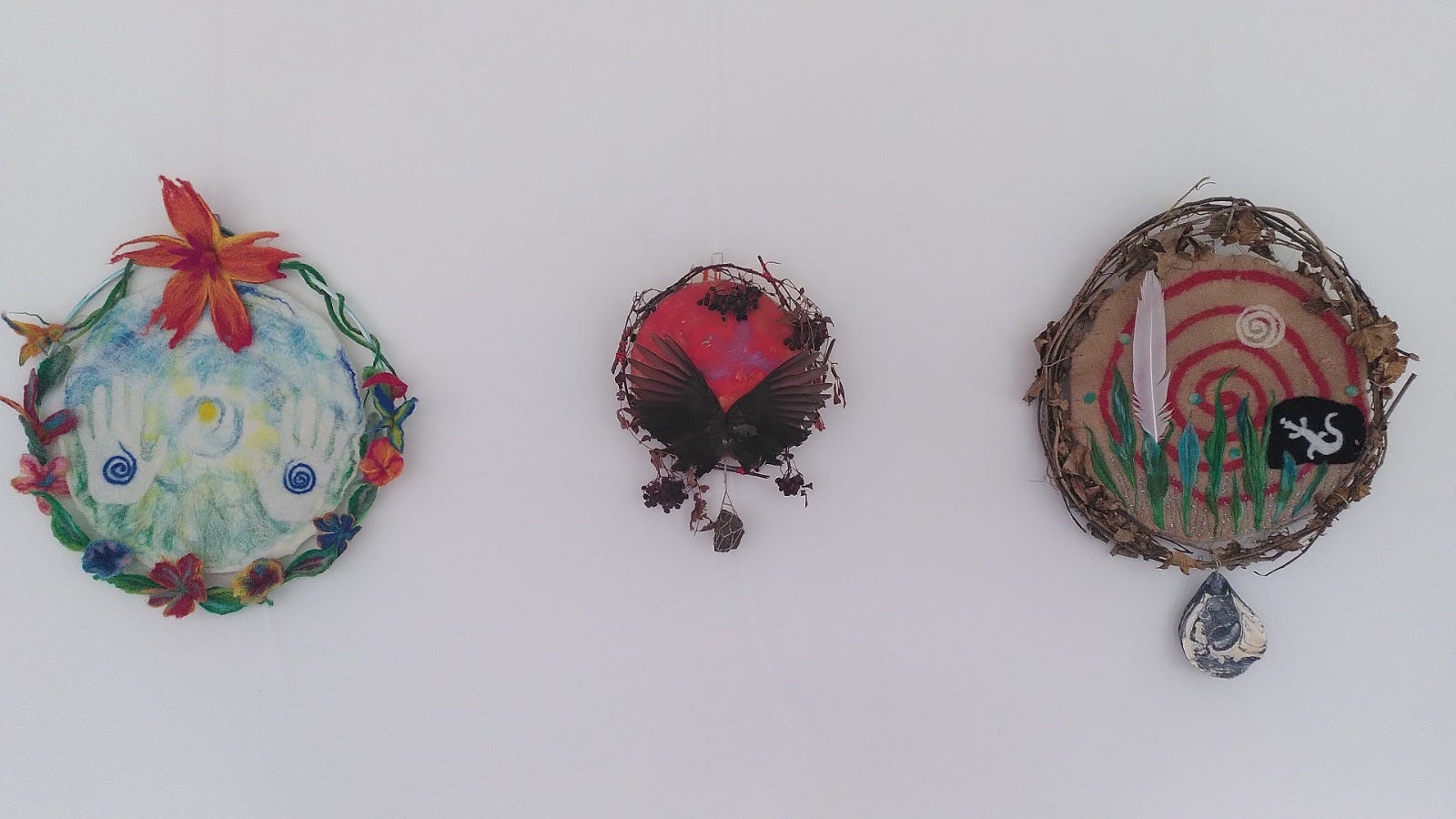
Inge creates felt shields that hang on the wall behind her, made after significant ceremonial experiences like sweat lodges or ayahuasca ceremonies. She works with wet felt and wool, building each piece from scratch using her hands, choosing colors intuitively. The process starts with an idea, but the work creates itself as she goes—never coming out exactly as she pictured it beforehand. After the felting process, she adds detail work with her sewing machine. These shields serve as visible representations of profound internal experiences.
Key takeaways:
Creates art as a way to make special ceremonial experiences visible and tangible
Works with wet felt and wool, building pieces entirely by hand from scratch
The creative process is intuitive and organic, flowing beyond initial concepts
Art serves as integration work, making internal transformation external
Key Insight: “When I have certain experiences that are very special to me, usually they have to do with some kind of ceremony. It could either be a sweat lodge or plant medicine. I like to make something out of it, to have it visible.” - Inge Van De Graaf
[26:57] What Fills the Space: Creativity Returns
When asked what occupied the time previously spent drinking, Inge described returning to walking and her Qigong practice—things she knew were important but often deprioritized when caught in the cycle of thinking she needed to do other “more important” things. Most notably, she started drawing again in the evenings for relaxation. She summarized the shift simply: “Creativity definitely started to flow again.”
Key takeaways:
Physical practices like walking and Qigong replaced evening drinking
Drawing returned as a creative outlet and source of evening relaxation
The tendency to deprioritize self-care diminished without alcohol
Creativity flourished in the space that opened up
Key Insight: “I started drawing again so that’s you know in the evenings for relaxation I love that stuff...creativity definitely started to flow again.” - Inge Van De Graaf
[31:46] The Research Shows: Consciousness Matters More Than Perfection
Inge referenced a research program called Christy that tracked participants’ drinking behavior through questionnaires once or twice a year. The outcome wasn’t that everyone quit drinking altogether, but that most people were drinking less and were more conscious of alcohol and the role it played in their lives. This perspective shift emphasizes awareness and intentionality over absolute abstinence.
Key takeaways:
Research supports that increased consciousness around alcohol creates lasting change
Complete abstinence isn’t the only measure of success
Awareness of alcohol’s role in life leads to more intentional choices
Regular check-ins and resets throughout the year compound the impact
Key Insight: “One of the outcomes of the program was that definitely not everybody quit drinking altogether, but most of the people were drinking less, and they were more conscious of alcohol and the role it played in their lives. So when you’re doing these resets throughout the year, imagine what an impact that can have.” - Inge Van De Graaf
Key Quotes
“A fear of being visible and not living the life that I would like for myself. And this would show up as an uneasiness in me.” - Inge Van De Graaf
“I also realized that when things show up here, it has to do with expressing oneself. I wasn’t expressing myself. I was keeping everything, well, just below the throat. I wouldn’t speak up. I wouldn’t say what I really wanted. I was making myself small. Drinking was a way of coping with that.” - Inge Van De Graaf
“With things that I really wanted to do, I would have to be visible. I would have to show up. And, yeah, that was so scary that I just was not going to do that.” - Inge Van De Graaf
“It’s a great practice to just be present at the bar and be okay with them drinking and me not drinking. And after going through this past month, I even have more confidence in that. Like, this is my choice. I’m not drinking. I don’t need to and I don’t want to.” - Inge Van De Graaf
“I started drawing again so that’s you know in the evenings for relaxation I love that stuff...creativity definitely started to flow again.” - Inge Van De Graaf
Resources Mentioned
De Reis naar Binnen - Inge’s practice name, meaning “the journey inward”
Praktijk van Inge - Inge’s current business name
Christy Research Program - Referenced study tracking alcohol consciousness and behavior changes
Qigong - Movement practice Inge returned to during the reset
The Sober Creative Reset - 31-day program Inge participated in
Where to Find Inge Van De Graaf
Inge Van De Graaf is a trauma therapist, medicine woman, and gatekeeper practicing in the forests of Drenthe, Netherlands. She works with regression therapy, plant medicine ceremonies, and deep subconscious healing through her practice, Praktijk van Inge.
Website and contact information available upon request for those interested in her work.
Thank You
A heartfelt thank you to Paul Overton, Rachel Connor, Noelle Richards, Phil Powis ❤️⚡️, Carolina Wilke and to everyone who joined us live for this conversation. A special thank you to Inge van de Graaf for her extraordinary courage and honesty. Your willingness to be visible makes these conversations possible.
Your Turn: The Sober Creative Reset
If Inge’s story resonates with you—if you recognize yourself in the gap between who you’re presenting and who you actually are, or if you’re curious about what might shift when you remove alcohol from the equation for 31 days—the next Sober Creative Reset launches in April.
This isn’t about willpower or perfection. It’s not about labeling yourself or committing to forever. It’s about creating space to see what’s actually there when you’re not numbing, performing, or staying small.
The reset includes daily prompts designed to be short and actionable, weekly group calls with guided meditations, and a community of individuals exploring the same territory. Some participants stop drinking entirely. Others drink less. All of them become more conscious of the role alcohol plays in their lives.


