


This is Normal
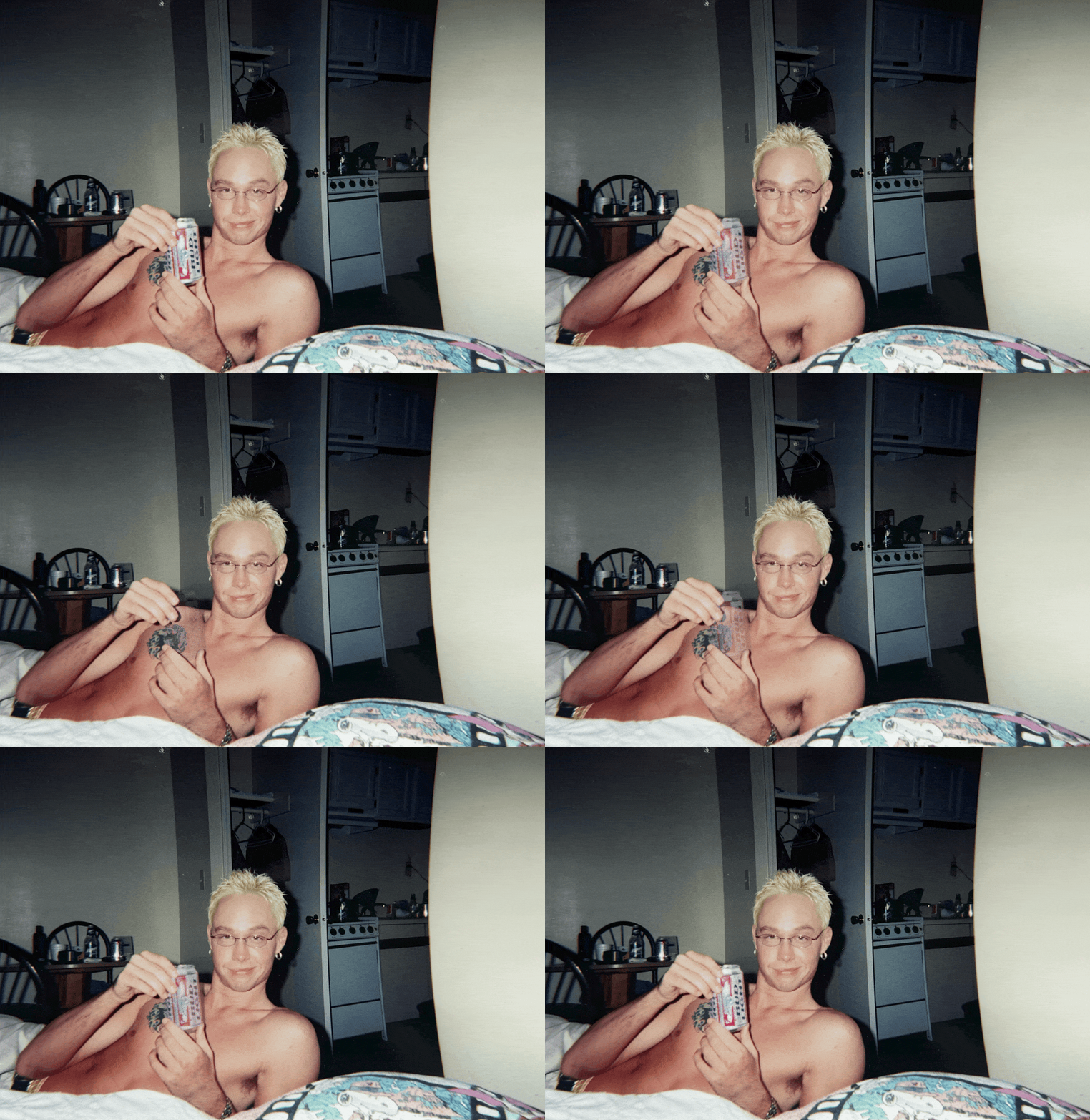
Pulling out a quarter-filled filled rotten milk jug from the fridge, leaving room for the case of Miller Lite. Check. Out of the bed of the truck, unloading the two large shiny kegs placing them on the back porch. Check. Jello shots. Liquor. Bags of plastic cups and ping pong balls. These were the weekends.
Tailgating before the game. BYOB. Slamming bags of ice on the ground at the gas station. There was no moment where I questioned whether this was a good idea because there was nothing to question. This was just life. This was normal.
I didn’t think of myself as someone who drank too much. I thought of myself as someone who drank. The same way I was someone who played fantasy football with too many teams or someone who worked in film, downing eight beers after an eighteen-hour day. It was facts. Neutral, unremarkable, woven into the fabric of how I moved through life.
There was never a question of should I be drinking? Not because I avoided it, but because it didn’t exist. There was no alternative self to imagine. No other version. I was this person. The person who has a beer in his hand at the cookout. The person who tried different IPAs just because of the colorful, intricate designed packaging. The person who drank until seeing double was the cue for bed.
The loop felt complete. Work, unwind, repeat. Show up, perform, recover.
I didn’t know the recovery was counterfeit. I didn’t know the unwinding was actually draining me. The system was designed to feel good and take the edge off.
That was the trap.
Nothing was Wrong
Drinking wasn’t something I did. It was who I was. The identity felt solid, so there was no crack for a question to enter. There was no version of me that didn’t drink. I couldn’t imagine him. And I didn’t realize what this pattern was actually doing.
It wasn’t just relaxation. It wasn’t just fun. It was access. Access to belonging. Access to belonging to a part of myself that felt true. Access to being part of the group without having to prove I deserved to be there. Access to not feeling the inadequacy, the not-enough, the pressure to perform in every room I walked into.
It was the gateway to an identity that felt safe. Without it, I didn’t know who I’d be. Not because I’d be worse. Because I couldn’t see that person at all.
Alcohol suppresses the prefrontal cortex—the part of the brain responsible for self-reflection, long-term thinking, imagining alternatives. It’s where questions like who could I become? and is there a better option? come from. The part of me that might have wondered about another version of myself was the same part being dulled night after night.
There was no space for doubt to enter. No moment of wondering if there was another way to belong. No moment to even consider another way to feel enough.
Every time I drank, that region went quiet. The system kept the questions out.
You can’t imagine another self when the part of you that does the imagining is offline.
A Crack Starts to Form
The pulsing echoes of feet hitting the rubber and …go shawty, it’s your birthday… is blasting through my ears. To my left and right, people are running their asses off. Me? I’m bent over, gasping for air. I look up at the screen of stats. My heart rate is in the red. There’s a voice behind me. My coach knew what was happening. The message was clear: I wouldn’t progress if I kept drinking like that.
That was the moment when a question would start to take shape.
I wanted health and vitality. I wanted progress. To be stronger, have more endurance, perform better in my lifestyle and creative work. But I couldn’t have both—alcohol and progress. The choice was becoming visible, even if it took me two more years to fully see it.
The costs continued to stack. Hangovers. Headaches. Digestion issues. Weight gain. Financial stress. The toll it took on everything was becoming too much.
I was exhausted. I was tired of being tired.
A question started to quietly push its way through. Faint at first, then louder.
Is it worth it?
The Signal
Drinking wasn’t something I wanted to give up. It was something I wanted to control. To prove I could drink better.
If I could just find the right system, the right pattern, the right amount of self-awareness—then I could keep it. Keep the person I was. Keep showing up to the cookout with a beer in my hand. Keep belonging. Keep fitting in.
Letting go completely wasn’t an option I could see. Because letting go meant admitting I couldn’t manage it. That I wasn’t strong enough. That I’d failed at something everyone else seemed to handle just fine.
It meant becoming the person who doesn’t drink. And I didn’t know who that person was. I couldn’t picture him at the tailgate, at the wedding, at the work wrap party. I couldn’t imagine him being interesting, being fun, being worth knowing.
The tracking, the journaling, the books—they weren’t about changing. They were about staying. Staying who I was while making the cost bearable. I still believed I could have both.
The body knows before the mind accepts. Tolerance builds—you need more for less effect. Sleep fractures—you pass out but you don’t rest. Your brain can’t properly process emotions, consolidate memories, or regulate stress. You’re operating in survival mode, managing symptoms instead of addressing what’s underneath.
The system wasn’t designed to let me have both. The more I tried to control it, the less control I actually had. Alcohol rewires the reward pathways. What starts as a choice becomes automatic. The subconscious decides to drink before the conscious mind even registers the option.
The tracking couldn’t fix that. The journaling couldn’t fix that. No amount of data or self-awareness could override a system that had learned to prioritize alcohol above rational decision-making.
The loop was revealing itself. Not broken yet—but no longer invisible.
The resistance I felt wasn’t weakness. It was information. My system signaling what my conscious mind hadn’t accepted yet.
The evolution of the question eventually revealed itself.
Do I need this?
The Practice Begins
The cursor slowly moves over the top of the post button. I stare at the white arrow about to make a terrifying decision. Click. August 19, 2020. I committed to one year of abstinence. Publicly. No quiet experiment. No “let’s see how it goes.” I told people I was doing it. I posted it. I removed the option to quietly slip back.
The questions flooded in immediately. What will my evenings look like now? What will social events be like? What will happen to my drinking buddies? What if I can’t do this?
This became a giant practice. I had to learn new activities to do at night. Step into dinners, parties, events, weddings as the person who doesn’t drink. Saying no when I was offered a drink. And even more importantly, feeling every single emotion that came with it.
This meant being with my thoughts without numbing them. Without turning away.
My new activities became a journey within. Books. Podcasts. Meditation. Classes. Group work. Coaches. Retreats.
It has been a journey of building a relationship with who I actually am and realizing the need for alcohol was slowly fading away.
Becoming
I became the person I couldn’t picture. The one I didn’t think could belong without a drink in his hand. Letting go didn’t make me weaker—it made me stronger than I’d ever been.
I now wake up at 4am ready to go. I train consistently in the gym. I’m conscious about what goes in my body. I show up on set with energy that’s fully present, not managing a hangover. I feel younger and stronger at 44 than I did in my twenties. This version didn’t exist when alcohol kept the questions out. He was built through practice. Through showing up. Through accumulated proof.
Every day without alcohol was building awareness. Every time I sat in stillness. Every sober conversation. Every project completed with clarity. The brain collected the data and updated who I was becoming.
The brain builds identity through a feedback loop: attempt, observe outcome, update self-concept. Each time you lead a meeting, navigate difficulty, show up fully present—the prefrontal cortex collects evidence about who you are. This isn’t motivation. This is how neural pathways form. How capability gets built into the structure of the brain itself.
Alcohol blocked that loop. Every night I drank, the evidence got erased. The progress reset. The person I was trying to become couldn’t form because the system that builds identity was powered down.
Sobriety restored it. And the prefrontal cortex didn’t just recover—it exceeded what it was before. Not because the damage reversed, but because I finally had the time and energy to strengthen what was always there. Creative problem-solving. Sustained attention. Breakthrough thinking. They operate at levels that weren’t accessible when half my capacity was spent recovering from the night before.
The loop is stronger now. Real recovery feeds real performance. Sleep restores. Clarity compounds. Trust rebuilds—not through promises, but through action.
Notice where your capacity is being drained by a system designed to restore you—but never actually does.
What might become possible if that loop were repaired? If you stopped spending energy managing the consequences of how you decompress—and instead decompressed in ways that actually rebuilt your capacity?
The work you’re capable of. The presence you bring. The trust you have in yourself. All of it lives on the other side of this question.
Who are you without the drink?
1:1 coaching designed to remove alcohol as the barrier to your full capacity.
If you’re ready for deeper, personalized support—The Sober Creative Method™ is a 90-day coaching experience that restores the conditions where clarity, energy, and creative capacity become reliable again.
This isn’t about labels or rock bottom. It’s about rebuilding your system so it works to reveal your potential.
The Framework: RELEASE → CREATE → BECOME
Through regular 1:1 sessions, WhatsApp support, and practical tools tailored to your creative work and life, we build the system that makes sobriety sustainable—not something you force through willpower alone.
“You can’t imagine another self when the part of you that does the imagining is offline.” That really struck me. I can’t even imagine a part of my brain being “offline”. The sections on belonging and becoming were big for me. How you had to learn to become a new person…so different than who you were before. Bravo!
wow that picture lol! Can't even recognize you josh!