


Quitting drinking doesn't give you your life back. It gives you an hour.
For me it was the one after five. I'd been thinking about it since two most days, so the night was decided before I ever got home.
When I stopped, I thought I was getting time back. What I got was the same hour with nothing in it.
The drink had been carrying something, and when I set it down the weight had to land somewhere. I didn’t decide where, so it picked its own spot. Mostly a screen. Sometimes food, sometimes a habit that was easier to defend in front of people and did the same job the drink had been doing.
Here’s what I understand about the craving. It shows up as a demand for action. Underneath it is a restlessness that won't settle on its own, and the body wants it gone in the next few minutes, not hours. Alcohol is the first thing it reaches for, because nothing else works that fast.
The first move isn’t to fill it. It’s okay not to fill it. If you go looking for something that works as fast as the drink did, you’ll find one, and it’ll be your phone. Nothing has to happen at six o’clock. You’re allowed to be bored, and being bored isn’t the start of something going wrong.
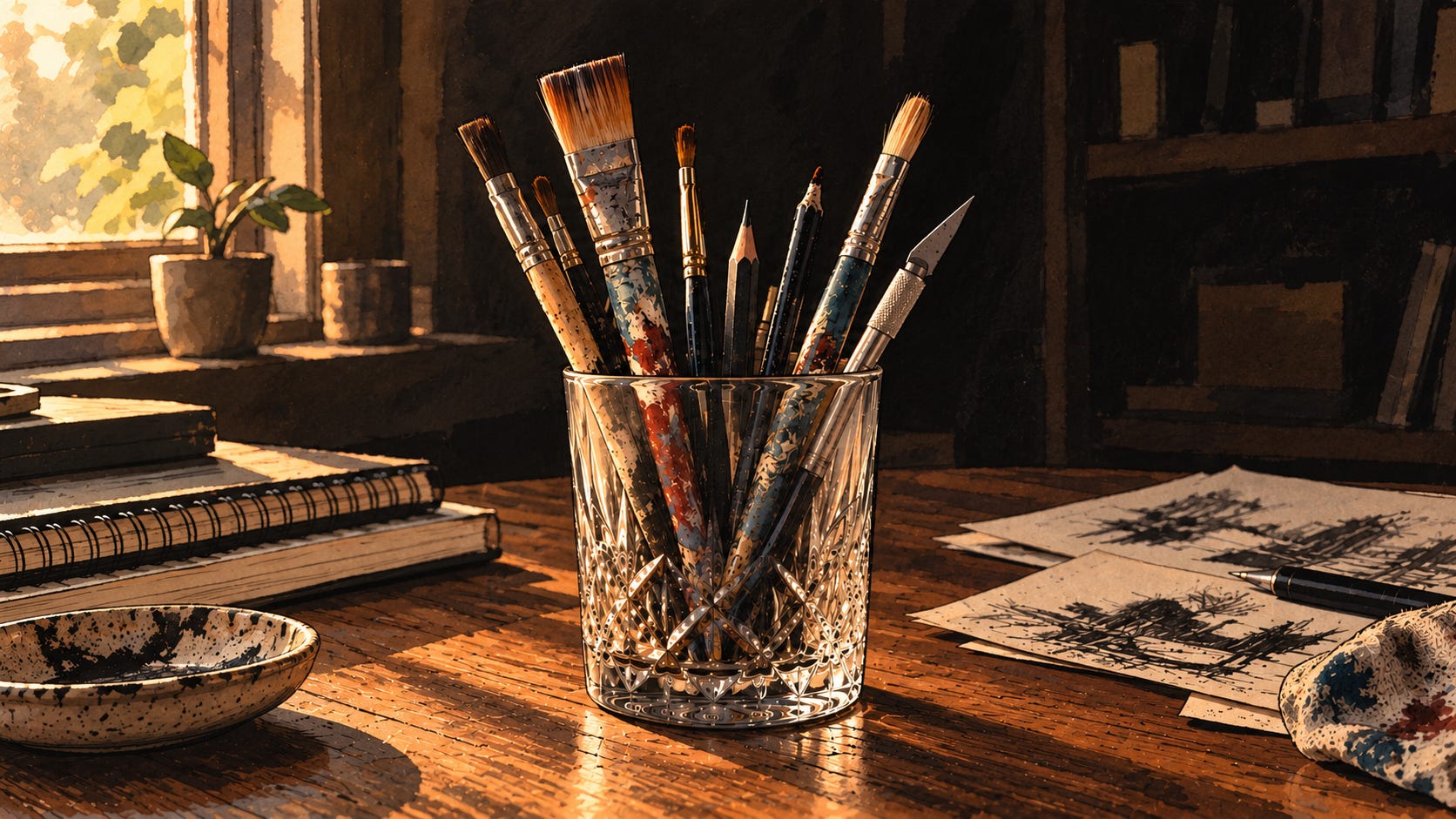
Bored only lasts for so long. So you make something. It asks for the same thing the craving is asking for, your hands and your attention and somewhere to put them. It takes an hour instead of a few minutes, which is the point. When it’s done there’s something in the room that wasn’t there before.
One sentence keeps the hour empty. It shows up before anyone tries. I’m not creative. I’ve never been a creative person.
People hand that word to somebody else, to the ones with the studio and the training and a show coming up, and then stand off to the side and watch.
It’s bullshit. You've been doing it all along, just without the name.
You found the way through a problem at work that three other people had walked past, and you never called it anything, because it was just Tuesday. You made the cupcakes for your kid’s birthday and decided what they’d look like before you started. The trip you planned got built around what the people with you would actually want, which took more imagination than most of what hangs on a wall. Dinner comes out of whatever’s in the fridge and it works.
Creativity is the plain human ability to picture something that isn’t there yet and then build it, and every one of us has it. What alcohol does is dim the part of you that does the picturing, night after night, until you stop noticing you ever had it. Then you call the absence a personality trait.
Now the harder part.
Under I’m not creative there’s usually a belief that something is missing in you. That other people got the thing and you didn’t. This goes back further than the drinking does.
Then the drinking stacks on top of it. Because you know what it’s costing you, and you keep doing it, and you carry that. So by the time you’re sober and staring down an empty hour with the idea of making something in it, you’re not starting from zero. You’re starting from underneath two loads at once, one that says you were never able, and one that says look at what you’ve been doing to yourself. That’s a lot of weight to bring to a blank page.
You can’t reason your way out of either of them. What moves it is sitting down and doing the thing, over and over, until there’s a stack of small proof behind you. Which means the practice doesn’t have to be a big thing in your head before it’s allowed to begin. It just has to begin.
Think about what’s in front of a painter. The blank canvas. The colors to pick from, the mediums, the brushes, the composition, and no end to what could be made out of any of it. Then the brush is in the hand and there’s the movement from the brush to the canvas. Flowing. Every stroke a rep.
Mine turned out to be clay.
A few years ago I took a six-week pottery class. It was something I’d wanted to do for years and kept putting it off. I fell in love with it, got a membership, and made a lot of mugs, most of which I gave away.
Here’s what an hour of it looks like. You get your station together. The tools, the water, the sponge that looks like a piece of honeycomb. You turn the wheel in the direction that works for you and set the speed on the pedal. You drop the bat over the pins. Then you cut a one-pound piece off the block, and what’s in your hand is clay and nothing else. You roll it and you knead it and you keep rolling it until it’s a ball. You slap it down on the center of the wheel. You press the pedal. You squeeze the sponge over it and the water runs through your fingers and down into the spin, and something comes out of nothing right there under your palms.
That’s the part the drink could never do. The best thing a drink gives you is a hangover the next day. What you create might be a gift. It might be something you sell, or something you throw away, and none of that matters. Either way it exists, and you’re the reason.
The proof isn’t the finished thing.
I made a mug early on that I was proud of. Put it in the kiln to be fired, came back a week later, and couldn’t find it anywhere on the shelf. I looked for a while before it occurred to me to check the scrap pile. There it was, broken.
My first thought was the time. All those hours, for nothing. And then that passed a lot faster than I expected it to, because the hours hadn’t been about the mug. They were about the making, and that was the part I still had.
That’s where confidence comes from. The shelf of things that survived has less to do with it than you’d think, which is also why the practice gives back far more than the finished product ever will.
Years into this, that hour stopped being something I had to solve at five o'clock.
It moves around now. It turns up in the morning, in the middle of an afternoon that got away from me, on a Sunday with nothing in it. At seven tonight I’ll be winding down and getting ready for bed, which would have sounded like a punishment to the version of me who needed that hour to go somewhere.
I liked the studio when it was empty. That hour on my own was one of the better things in my week.
The class was a different thing. There was an energy in that room that came from being near other people working, seeing how somebody set their station up, how they handled the clay, what they were trying that I wouldn’t have thought of. And every so often somebody would stop and say something good about something I’d made. Nothing formal. Just noticed.
The voice that asks who you think you are gets a lot smaller in a room like that.
So watch for the hour in your day that isn’t doing anything for you. Most of us have one.
The hour is yours to create.
I like the subtitle - "what goes in its place" - but at first I was struggling to relate to your "block of clay into a mug" - then I realized this is what I do with words - 26 letters arranged and rearranged until the make sense and connect me with other people. Fun!! Yes, I needed something other than inebriation to satisfy those neurons - I've had many years to arrive at the mental mix - but it requires work - much more complicated than numbing, but also infinitely more rewarding.