


![Steve [Sage-Outlaw-Caregiver]'s avatar](https://substackcdn.com/image/fetch/$s_!MZ3X!,w_108,h_108,c_fill,f_webp,q_auto:good,fl_progressive:steep/https%3A%2F%2Fsubstack-post-media.s3.amazonaws.com%2Fpublic%2Fimages%2Fd1dfd0af-613f-42ec-93e8-c481f63535ec_1254x1254.png)
Steve [Sage-Outlaw-Caregiver] on the crash that came six years after he quit, and finding out at 40 that he was creative
Steve didn’t take a drink until he was 21. He calls it a reverse Benjamin Button. Most people get their worst drinking out of the way young. His started late, got heavier every year, and by the back half of his 30s it was every single day.
He stopped on August 4th, 2018, after his drinking got him sent home from a post in South Africa. There was no program and no meetings. He was so depressed he couldn’t leave his room, which broke the habit before he ever decided to break it.
Then nothing was fixed. Six years later, still sober, he was diagnosed with ADHD, watched two decades of near-perfect performance reviews collapse, went through termination proceedings, and checked himself into inpatient care in the Colorado mountains because he couldn’t guarantee his own safety.
Almost none of what he found there had to do with alcohol. It had to do with a man who had spent his entire adult life believing he was his job. What he built on the other side of it is a dog wellness company and a world of corvid characters he draws with AI, which is not where a career foreign aid officer expects to end up.
A note before you read on: Steve speaks openly about depression and two suicidal episodes. He gave his full blessing to share it. If any of this hits close to home for you, please reach out to someone you trust.
Show Notes
[02:36] A Late Start That Got Worse With Age
Steve went to Tulane in New Orleans, a heavy drinking town, and mostly ran with the engineering and finance crowd. He barely drank in college and never blacked out there.
After graduation he took an internship with the Department of the Army and landed in a cohort with a real drinking culture. Classes ended at three and the group went straight to margaritas.
He moved every two years, served overseas with soldiers, and drank his way into every new room. He describes himself as a chameleon during those years.
By the second half of his 30s, it was daily.
Key Insights
“It seemed like a shortcut. So that’s how I kind of just got sucked into it.”
[11:15] When Drinking Flipped From Fun to Function
Steve rose fast, three years with the Army and then 17 at USAID. Every promotion brought a fresh wave of imposter syndrome.
He was moved from Washington, D.C. to South Africa to run a large office. He remembers blacking out one night because he had to fire somebody the next morning.
The circle kept shrinking. Five people at the bar became three, then two, then just him.
Drinking stopped being about having no responsibilities and started being about having too many.
Key Insights
“It becomes less of a social thing and more of a, this is just something I need to do.”
[14:26] August 4th, 2018
His drinking started affecting his work. He was sent back to the United States from South Africa.
The depression that followed was so heavy he couldn’t get out of his room, so he stopped drinking without ever making a plan to.
He had to leave his dogs behind in South Africa for two months and wasn’t allowed to visit them.
He never went to AA. He just stopped.
Key Insights
“August 4th is the day I returned to the United States and I thought my life was over.”
[17:45] COVID, ADHD, and the Loss of Structure
Working from home stripped away the outside structure that had been holding him together. His ratings dropped from an average of 4.5 out of 5 down to threes, twos and ones.
He wanted to start drinking again. He went to therapy instead and came out with a diagnosis of ADHD and major depressive disorder.
Leadership gave him no coaching and no useful feedback, and he couldn’t work out what was happening to him.
Between 2020 and 2024 it built into a crash, and a second suicidal episode.
Key Insights
“What I found out is the lack of structure was killing me and I couldn’t figure out what was wrong with me.”
[21:26] Losing the Job That Was His Whole Identity
Bad reviews turned into termination proceedings. He believed it was all his fault.
He checked into inpatient care in Colorado expecting a short stay. He thought he was better, wasn’t, and stayed a second month.
In 2025, USAID was dismantled and his 17-year career ended outright. Having the job taken from him did what he couldn’t do himself.
He had stayed off social media for 20 years. Substack is where he landed after.
Key Insights
“I was finally able to break Steve away from Steve, the USAID worker.”
[23:07] The Depression Equation
Steve built himself a simple formula for what was happening to him, and then built his day around beating it.
His answer was to get outside, so he started walking dogs. It slowly dawned on him that this could be an actual life.
Buddhist teachings on attachment had been floating around his life for years without landing. They landed now.
He got obsessed with space, and found the scale of it comforting rather than frightening.
Key Insights
“Depression equals being at home. Being alone and in your own head. So at home plus alone plus in your own head equals depression. It’s just an equation.”
[26:02] Finding Out He Was Creative After All
Steve was a numbers guy and a spreadsheet guy who was certain he had no creativity in him at all.
Art therapy in Colorado cracked it open. He drew stick figures and it felt good anyway.
AI became the tool that closed the distance between what he could picture and what he could make.
He learned he wasn’t a burden on the people around him, a belief that had shaped how he lived for decades.
Key Insights
“Didn’t think I had any artistic bones in my body or any kind of creativity ever.”
[33:15] Outside Feet, Artificial Idiocracy, and What Creativity Actually Is
“Outside feet” is what Steve says to his own dogs when he’s putting his shoes on. He built the company name around that instead of a pet pun.
Artificial Idiocracy started as a joke about being the average person stuck between the pro-AI and anti-AI camps.
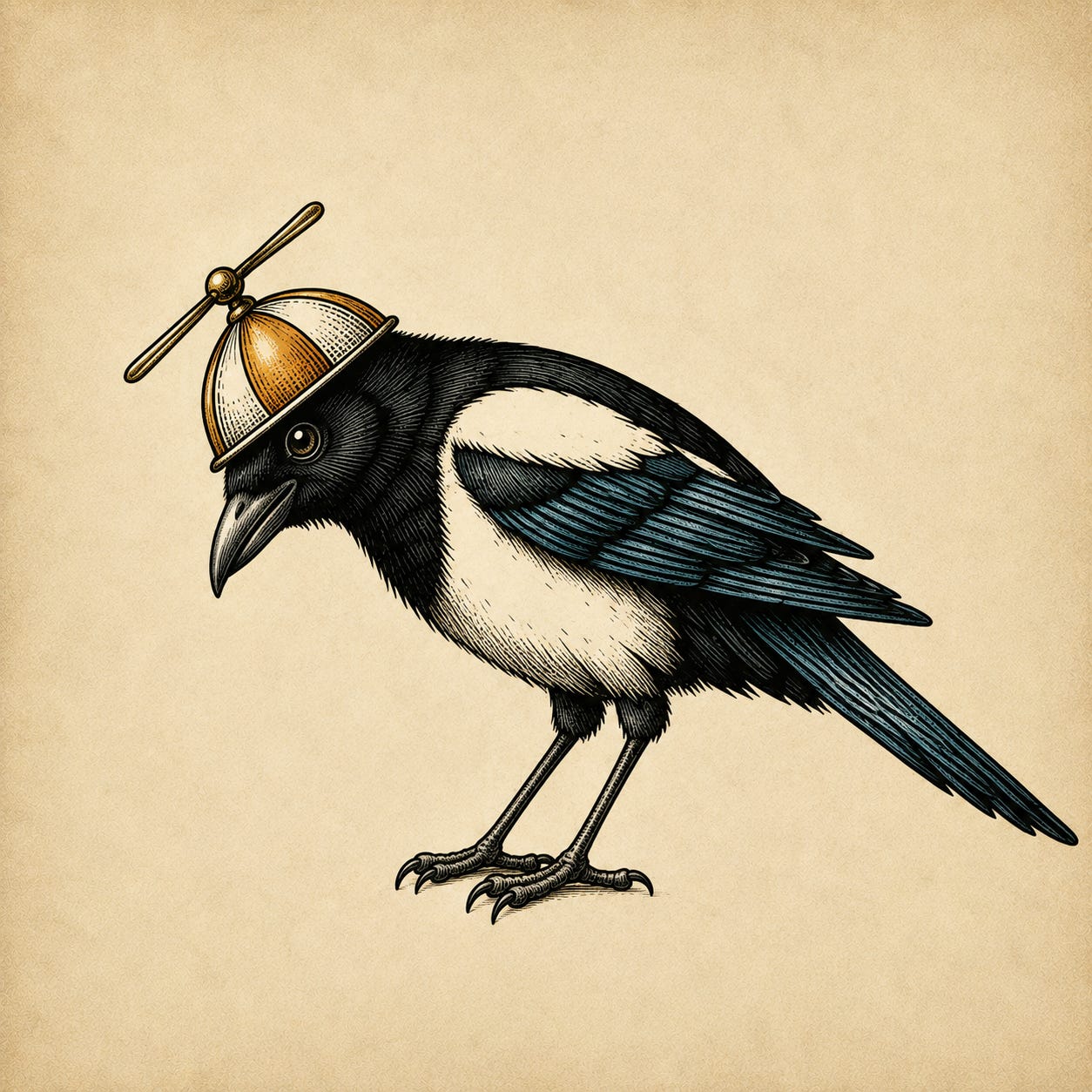
He’s building a Renaissance-punk world of corvid characters modeled on writers he admires on Substack, studying their sites, words and mannerisms before he designs each one.
He now makes less money than he did at USAID and says he’s happier.
Key Insights
“It’s just being open and being honest is what I think creativity really is.”
[39:07] The Dossier
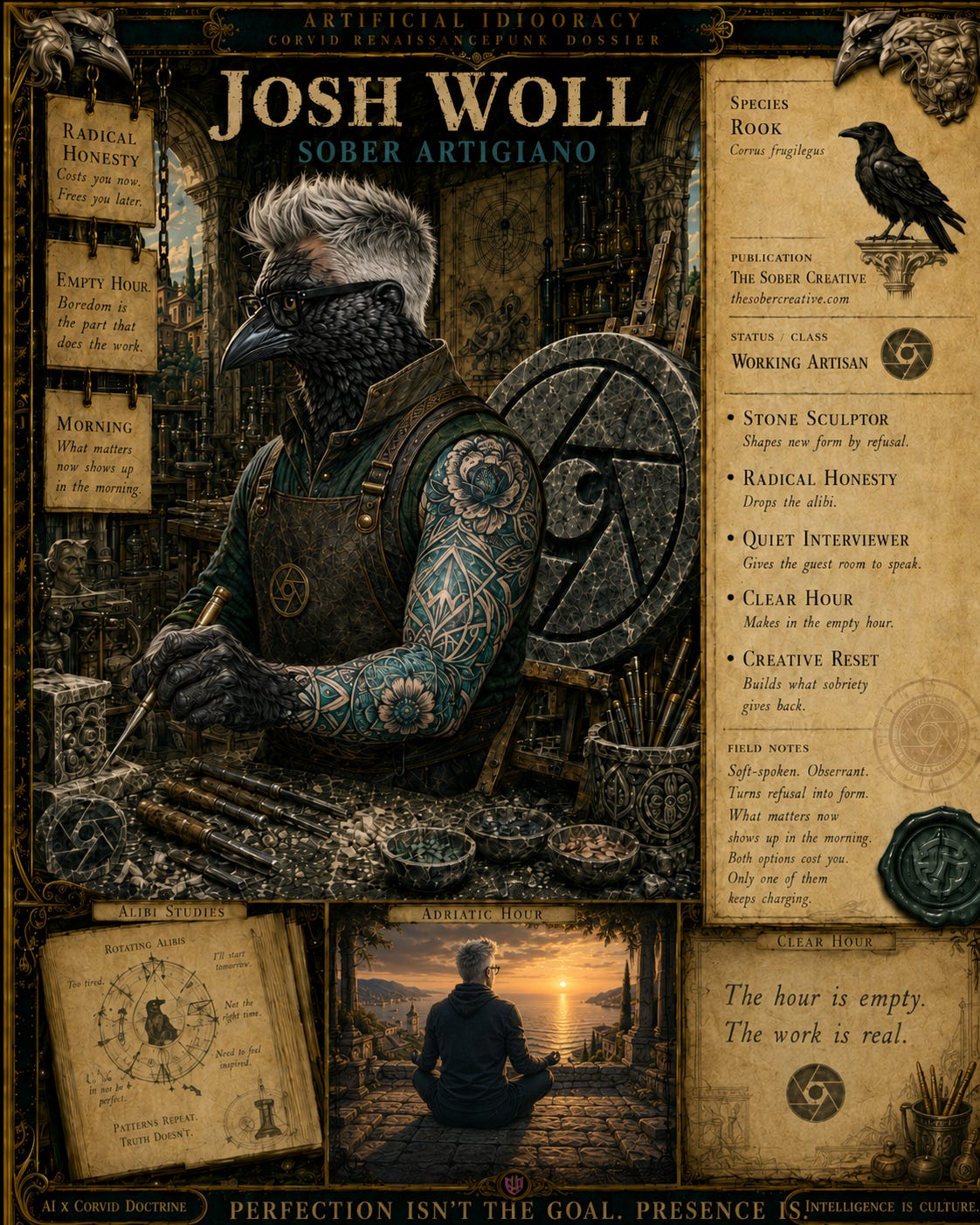
About forty minutes in, Steve shared his screen and showed me the character he’d made for me.
I’m a rook. He picked it on purpose. Ravens are loud and shouting all the time, and as he put it, “the rooks are a little bit more introspective.” He called the character a sober artigiano, a working artisan, and drew me as a stone sculptor. His description: “creating something out of something very raw, but you’re shaping it into something beautiful.”
He gave it a full dossier. Species, publication, class, a list of traits. Stone Sculptor: shapes new form by refusal. Radical Honesty: drops the alibi. Clear Hour: makes in the empty hour. Creative Reset: builds what sobriety gives back. He’d read enough of my work to pull The Alibis into a panel of its own, put the arm tattoo on the sleeve, and put me sitting in meditation at sunrise. Along the bottom it reads: Perfection isn’t the goal. Presence is.
This is what he does now. He studies a creator’s work, their words and their mannerisms, and builds them a character in a Renaissance-punk world of corvids. “I studied their sights, I studied their words, I studied their mannerisms.” Then he gives it away.
A man who spent 40 years certain he had no creativity in him made this. That’s the whole episode in one image.
Key Quotes
“For me, my entire life, my identity, my worth was tied up with my job.” — Steve
“I just decided I needed to go to inpatient because I couldn’t guarantee my own safety.” — Steve
“I’m not a burden to anybody. In fact, people like helping other people.” — Steve
“The materialism is not the key to happiness. It is something within you and the community around you that has that happiness.” — Steve
“I’m not here to promote anything. I’m just here to be myself. And that’s the greatest thing I can pick up right now.” — Steve
Resources Mentioned
The Alibis

My essay on the excuses we use to keep drinking. Steve brought it up on his own and recommended it to listeners.
Art therapy — where Steve first drew anything as an adult, during his inpatient stay.
Buddhist teachings on attachment — ideas that had been around his life for years and finally took hold after he lost his job.
Corvids and the Renaissance — the two sources behind his Renaissance-punk character world. Ravens, crows, jackdaws, nutcrackers, rooks and jays.
The Clear Hour — my free monthly gathering. A short guided practice, then everyone works, then we come back and share.
Where to Find Steve
Outside Feet: outside-feet.com — daily dog wellness in D.C. and Montgomery County
Artificial Idiocracy on Substack, where the corvid characters live
Mostly, he’s in the notes. In his words: “Always happy to talk with people.”
What Steve’s Story Says About Structure
Steve quit drinking in 2018 and stayed sober. Six years later he still crashed.
What took him down was the loss of structure. No outside scaffolding, no daily contact, no one checking in on how he was actually doing. He said it plainly: the lack of structure was killing him and he couldn’t figure out what was wrong.
That's the piece most people skip. They stop drinking and leave everything around it exactly as it was.
The Sober Creative Reset is 30 days of structure while you take alcohol out. Four weekly 60-minute sessions with me one-on-one, daily email check-ins with a reflection prompt, trigger and pattern mapping, and tools to steady your nervous system when it gets loud. When you slip, we adjust the plan instead of starting over.
It’s $497 for the 30 days, about $124 a session, and you can cancel anytime. It isn’t therapy, rehab, or AA. It’s coaching built from having walked this myself.
If you want to talk it through first, book a free clarity session from the page. No pressure either way.
Thank You
A real thank you to Steve for showing up as himself, yellow glasses and all, and for talking about the hardest parts of the last few years without flinching. And thank you to Florence Acosta, EG, Love conquers hate, Duncan The Sage, and many others who joined us live and hit those buttons. These conversations happen because you show up for them.


![Steve [Sage-Outlaw-Caregiver]'s avatar](https://substackcdn.com/image/fetch/$s_!MZ3X!,w_96,h_96,c_fill,f_webp,q_auto:good,fl_progressive:steep/https%3A%2F%2Fsubstack-post-media.s3.amazonaws.com%2Fpublic%2Fimages%2Fd1dfd0af-613f-42ec-93e8-c481f63535ec_1254x1254.png)


