


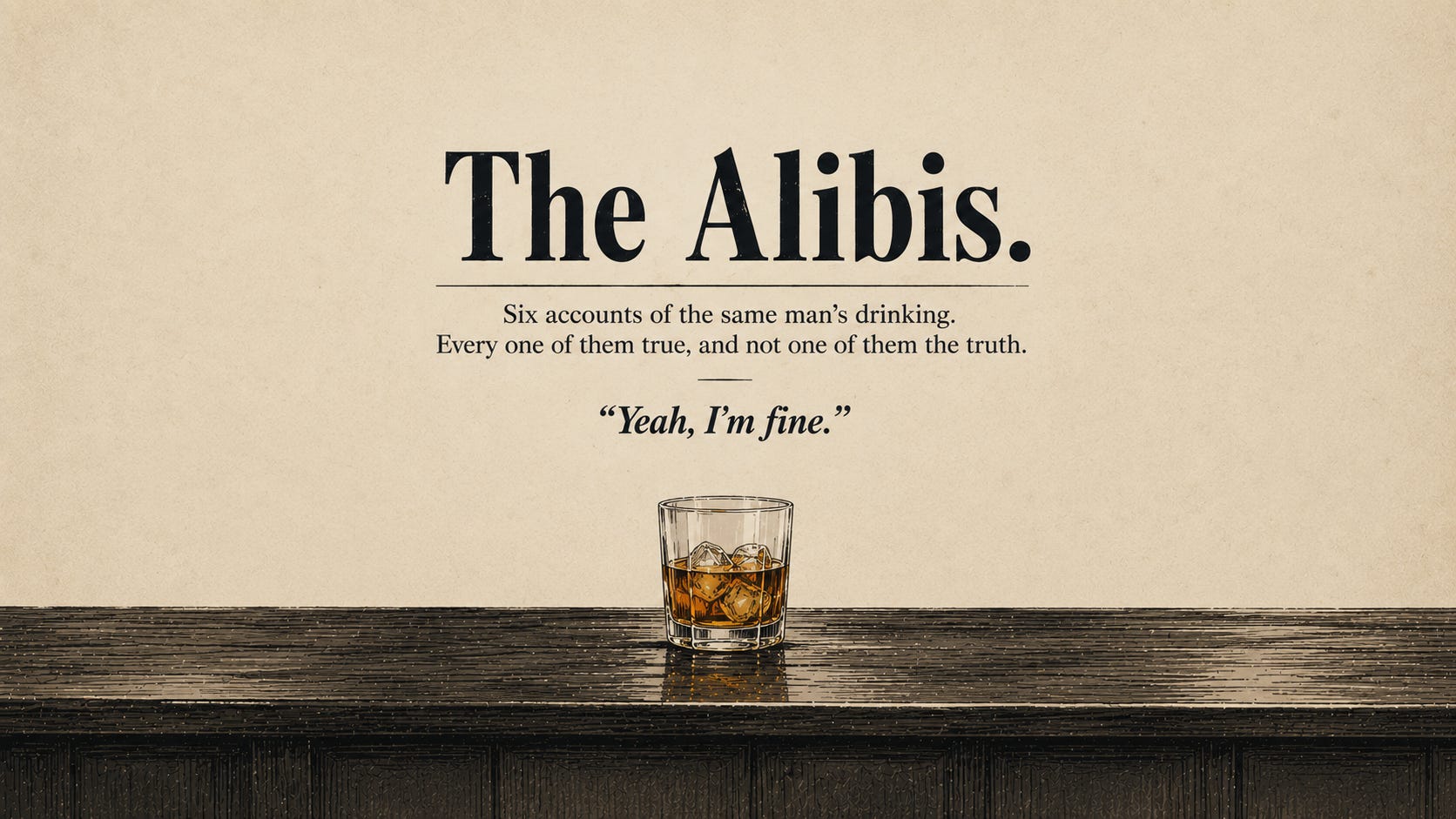
Somebody asked me once if I was sure I wanted another one.
I said I was fine. That was the whole exchange, and it worked, because nobody keeps pushing a person who says he's good. The question went away. The drink came and the night kept going, and some version of that happened more times than I could count.
Nobody in that room was fooled about how much I drank. They could see the glass. What they couldn't see past was how reasonable I sounded about it.
I wasn't lying to them either. That took me years to understand. In the second I said it I believed it completely, because some part of me had already reviewed the evidence and issued a ruling before my mouth ever opened.
That’s the difference between an excuse and an alibi. An excuse is what you hand your friend, and you know while you’re handing it over that it’s an excuse. An alibi is the story you hold as true. You would sit for questioning on it. You would take it into a courtroom and win the case, and every one of them checks out, which is why nobody ever talks you out of one.
So an alibi was never hiding anything. It was granting permission, and it worked on the room as much as it worked on me.
Mine was never one story. It was a rotation. When the drinking came up at work I had a different story than the one I used at home, and a different one again for the version of the question that showed up in my own head at two in the morning. Each one was built for its own room. Each one was airtight in that room.
So here they are. Six of them, and they’re one man, because that’s what they are. Not six people at a bar. One person with six ways of explaining himself, and the sixth is always ready by the time the fifth runs out.
There’s a seventh at the end. That one was the hardest to let go.

Everyone has one. The guy from college who’s still posting from the bar at one in the morning. The brother-in-law nobody wants to sit next to at Thanksgiving. He drinks more than you do, and he has for years, and every time the question comes up in your own head, he answers it before you get anywhere near an honest look.
What makes this one hard to shake is that it’s accurate. He really is worse. You aren’t stretching anything, and some part of you knows it, which is why the comparison feels like evidence instead of a dodge.
The move underneath is that you get to pick the standard. And you always pick one you clear.
Facing it means dropping the comparison entirely and asking a smaller question about your own life. What the drinking is taking from you, at your pace, on an ordinary week with nothing going wrong.
He was doing you a service the whole time, and the fee was every honest look you didn't take.

The week really was bad. That’s the part people get wrong about this one. There was a deadline, and the car needed work, and somebody’s mother is sick, and none of that is invented.
Then the following week there’s a wedding. Then the in-laws. Then a stretch at work that everybody warned you about.
Notice what the reason is actually doing. It isn’t causing the drink, it’s clearing it, turning tonight into a response to something rather than a thing you were going to do anyway. And the supply never runs out, because life keeps producing weeks.
Facing this one is simple to describe and uncomfortable to do. Stop asking whether tonight is justified. Look instead at what happens on a night with nothing wrong at all, when the week was fine and the day was fine and the drink shows up anyway.
The reasons were always free. The nights they bought you were not, and you paid for those one morning at a time.

This is the one that holds longest, and it's the hardest to argue with, because the record is spotless.
She finished the double. He ran the meeting and nobody could tell. The kids got picked up, the deadline got hit, the flight got made. Nothing has fallen over, and in a culture that measures a drinking problem by what it wrecks, nothing wrecked means nothing wrong.
Except that performance answers a question nobody was asking. Whether you’re still functioning and whether the drinking is costing you are two different measurements, and one of them has been standing in for the other.
Facing it means looking one level below the output. Not at what got done, but at what it took to do it. How you sleep. How much patience you have left at eight in the evening for the people who actually live with you.
Which means admitting that something can be wrong while everything looks right. Nothing ever fell over. Holding it up took more every year, and the extra came out of your evenings.

He knows the region, the producer, the year. That’s real knowledge and he came by it honestly.
The same move works anywhere a person has built a vocabulary around it. The cocktail with three ingredients and a technique. The bourbon shelf that’s a collection. The two glasses that go with cooking, poured before the pan is even hot, part of how the evening starts.
None of that hides the drinking. It reframes it. The pour becomes a tasting, the bottle becomes a purchase you researched, and the whole thing files itself under something you’re good at rather than something you do a lot of.
Facing it means separating what you know from how much you drink, because those two have nothing to do with each other, and one has been vouching for the other for years.
You can keep the knowledge. You never lost that. What you lost was the count, and the count was the only thing that could have told you anything.
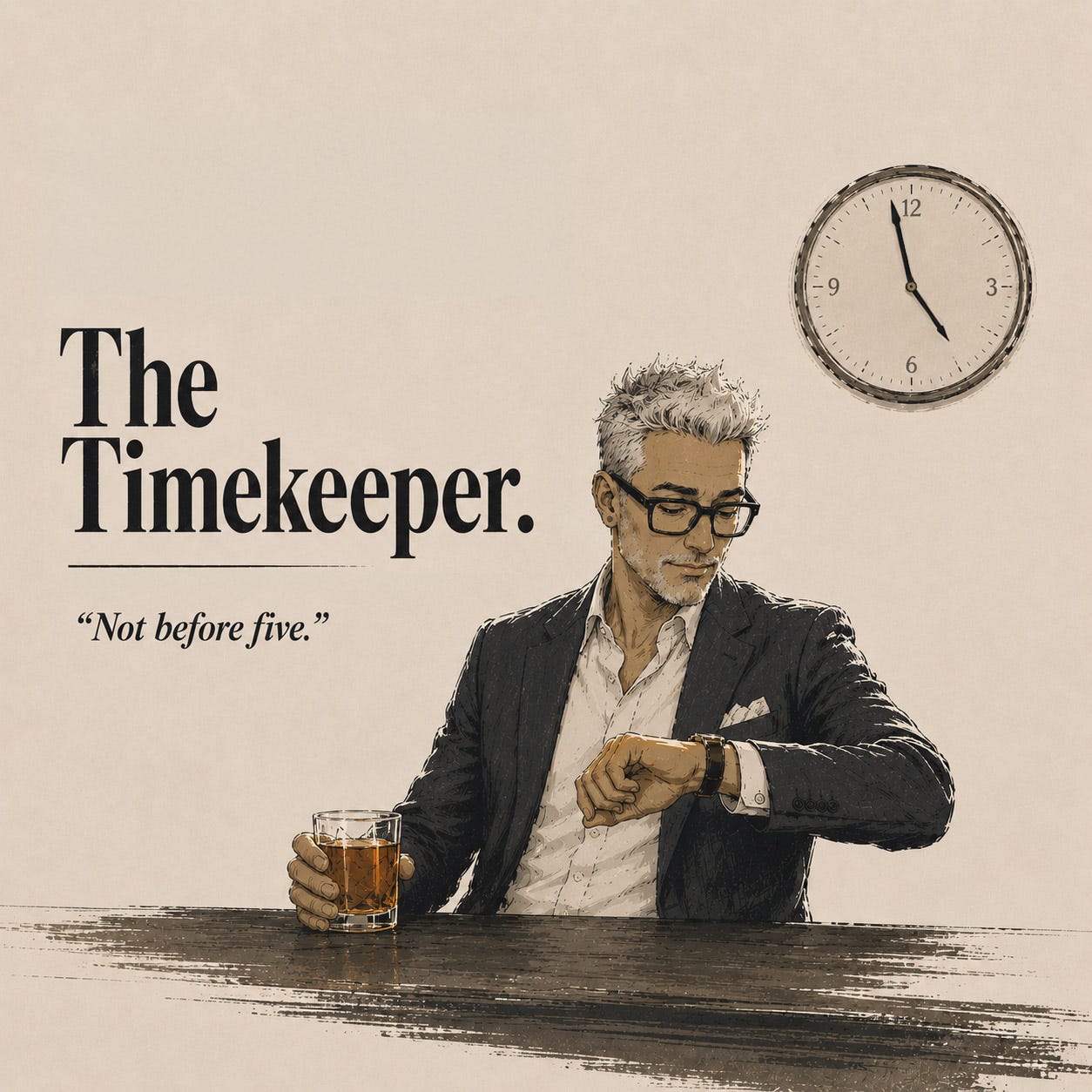
The rule has held for years. That’s not nothing, and the people who run this one are usually proud of it, because they know plenty of people who don’t have a rule at all.
Never before five. Never at lunch. Never on a work night. Whatever the line is, it gets checked every single day, and it gets cleared every single day.
The rule doesn’t limit the drinking. It certifies it. Once five o’clock arrives you’ve passed the only test you set, and everything after that is authorized, which is why the pour keeps growing while the rule stays exactly where it is.
Facing it means measuring what you’ve been leaving out. The size of the pour. The number of nights. How long after five, and how many after the first.
Every evening, that rule handed down a verdict in your favor. It never cost you a night in all those years. A limit you never feel isn't limiting anything.

Beer only. Weekends. Never alone. Two max.
Written down, in some cases, and followed to the letter for years. The people running this one are disciplined, and the discipline is genuine, which is why it works so well as a defense of themselves.
But look at who wrote the rules. Every one was drafted by the part of you that wanted to keep drinking, and every one was built to be passable. A rule that would actually threaten the drinking never makes it onto the list, and if one accidentally does, it gets revised the first time it becomes inconvenient.
So the rulebook isn’t restraint. It’s a permit, written by the applicant, renewed nightly. Following it feels like control because it takes real effort, and the effort is the part that convinces you.
Facing it means asking what a rule would look like if it wasn't written to be kept.
You followed every rule you wrote. The rules kept the drinking.

This is the seventh, and it’s mine.
It didn’t happen at a bar. It happened at six in the morning, alone, staring at the ceiling, telling myself I was done and meaning it completely.
The Promiser is the only story on this list with no audience. Nobody was there to be convinced, which is what made it so confusing, because I wasn’t managing anyone’s impression of me and I still couldn’t hold the promise for a day.
What I understand now is that the promise was made by somebody who wouldn’t be around to keep it. The body repairs itself faster than the memory holds. By five in the afternoon the misery had faded into a story about a rough night, and the man telling that story had different priorities than the one flat on his back at six.
So I tried to solve it with information. For two years I tracked it. Whether I could skip a night when I was in a good mood. Whether I could skip one when I wasn’t. Whether Tuesdays were the problem. Whether staying dry Monday through Thursday would earn me the weekend.
I thought I was gathering data. Every variable I tracked was a way to keep drinking, and I never once tested a version where I stopped.
The negotiating didn’t end. It got more sophisticated.
The Bill
Denial never takes anything all at once. It takes a night, then a morning, then a stretch of months you can’t fully account for, and it bills you for the comfort in payments small enough that none of them ever gets your attention.
It runs on a schedule you never agreed to. The evening is easier, so tomorrow starts a little later. The morning is slower, so the day gets shorter. You are a little less available to the people who live with you, and none of it is dramatic enough to name, so nothing gets named.
Then there’s what the stories cost to maintain. Every one of them has to be watched. You track who has seen how much, and which story you used in which room, and whether tonight lines up with what you said last week. That’s real work, and it runs in the background of every dinner and every trip and every ordinary Wednesday, and it’s exhausting in a way that never shows up as exhaustion.
And the whole time you are getting better at it. The stories get more refined, the answers come faster, and the case gets stronger, which means the thing you built to protect yourself becomes harder to take apart the longer it works.
That’s the cost. Not the crisis you kept watching for and not the wreckage that would have made it obvious. Just the years that went by while you were building the case, and the version of your life that was running underneath it the whole time.
Denial comforts you now and costs you later. Acceptance costs you now and frees you later. Same ledger, opposite direction, and you’re the one choosing which side you pay on.
The bill was always in your name. You signed for it every time you said you were fine.
The Last Negotiation
I went from forty-eight beers a week down to one or two.
That took a long time and it was real. As far as anyone could tell, I had solved it. Nobody was worried about me, and there was no crisis waiting at the end.
But at one or two there was still room to have more, and I was the one who got to decide.
So I committed to a year without it.
I had spent two years trying to control something that was going to do damage at any setting. Control was never the project that would work. It was the project I kept choosing so I wouldn’t have to pick the other one.
Looking back at those two years, I don’t see failure. I was working my way up to quitting. I just didn’t know it yet.
If you’re tracking your Tuesdays right now, that isn’t the wrong instinct. It’s the beginning of one, pointed at the wrong question.
And if that’s where you are, working your way up to something you can’t name yet, that’s most of what I do now. The Reset is thirty days, one on one. Not a test to pass. Thirty days of looking at it with somebody else in the room, which is the one thing I never had while I was building the case against myself.
This hit hard. The strongest part for me is how the “rules” slowly become excuses. Real change starts when we stop negotiating with ourselves.
Great post, Josh! Thank you for sharing!