



In this episode, Josh sits down with Hunter Biden, a painter and writer based in Los Angeles who built a first career in law and business long before most people knew his name for anything else. Then one October, a laptop turned his private life into public property overnight. Every family photo, every relapse, and every unfinished thought got picked up by strangers and rearranged into a story he never wrote.
What makes this conversation stand out is how plainly Hunter talks about the parts most people would keep hidden. He calls addiction “never an excuse,” but insists it can be an explanation. He traces almost every bad decision he’s made back to fear. He talks about the accident that killed his mother and sister when he was three years old, the decade of relapse that followed his first stint in rehab, and the moment a total loss of privacy left him with what he calls a binary choice: get up and live, or find a way to die.
By the end of the conversation, Hunter has moved past the scandal. He talks about a paintbrush his wife Melissa bought him at a used furniture shop, about finding purpose in a single afternoon of painting, and about why being of service to other people secures his sobriety more than anything else.
This is a conversation about what happens after the worst thing you can imagine happens to you, and what you build with what’s left.
Show Notes
[00:00] Meet Hunter: From Scandal to the Studio
Josh introduces Hunter as someone whose entire digital life was leaked from a laptop one October, turning private photos, relapses, and unfinished thoughts into a story other people wrote for him.
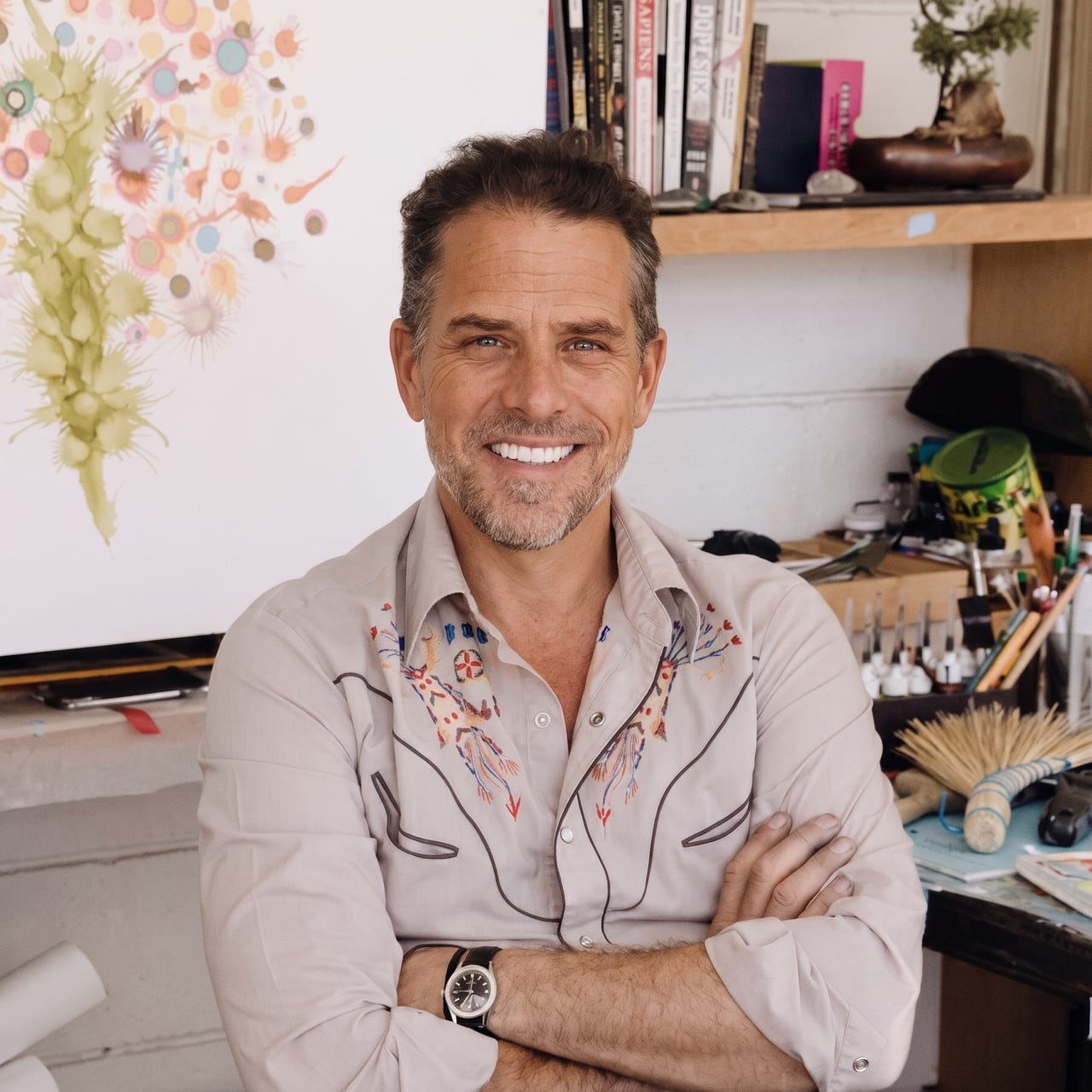
Seven years ago, at a point where Hunter says he could no longer trust his own mind, he picked up a paintbrush and started working in alcohol ink, acrylic, and Pointillism.
Hunter now paints in Los Angeles and writes about his experience on Substack, correcting himself in public when his memory proves him wrong.
Key Insight: “That was the most beautiful introduction I’ve ever gotten.” - Hunter
[02:08] A Beautiful Childhood, Filled With Trauma
When Hunter was about three, he and his older brother Beau were in a violent car accident with their mom and little sister. Rescue workers used the jaws of life to free them.
Hunter’s mother and sister died in that accident. He and his brother spent a month or more in the hospital together afterward.
His Aunt Valerie, Uncle Jimmy, and the rest of his family rushed in to rebuild their lives, and Hunter calls his dad “the best dad I know.”
For years, Hunter didn’t let himself believe that early trauma played a role in what came next.
Key Insight: “I had an incredibly beautiful childhood filled with trauma.” - Hunter
[05:01] The First Drink and the Cycle of Shame
Hunter remembers his first sip of alcohol at age eight, sneaking a champagne flute at a party and feeling like everything missing in him had suddenly been filled.
His drinking progressed through high school and college, and he went on to graduate from Yale Law School.
By his early thirties, Hunter knew his drinking wasn’t normal. He made himself promises: only drink on weekends, only drink beer, no Jack Daniels. He broke every one of them.
Breaking those promises started a cycle of shame that became, in his words, the thing that locked him into relapse.
Key Insight: “When I would break that promise, I decided it was easier to hide that and lie about it than be honest with myself or anybody around me.” - Hunter
[07:42] Rehab, Relapse, and the Ten-Year Spiral
On September 12, 2003, Hunter’s brother told him he needed to do something about his drinking. Hunter went to rehab and stayed sober for close to seven years.
After his first relapse, Hunter entered a ten-year cycle that got progressively worse, moving through rehab, short stretches of sobriety, and binges.
The spiral ended in a serious addiction to crack cocaine alongside daily heavy vodka drinking, which continued for about two years before Hunter got sober in June 2019.
He’s careful with his language today. He calls himself “substance free and sober,” not “clean.”
Key Insight: “More than anything, though, what I learned is that I wasn’t alone.” - Hunter
[13:56] Radical Honesty Requires Radical Self-Love
Hunter talks openly about the parts of his story most people keep private, including smoking crack and being in situations involving prostitutes.
He believes addiction is never an excuse for behavior, but it can be an explanation, both to other people and to yourself.
He credits an idea from Chase Hughes: real healing takes being “almost delusional in your self-forgiveness,” without giving up accountability or the work of making amends.
Key Insight: “Until you can truly love yourself, it is almost impossible to truly accept and receive love.” - Hunter
[15:43] Seen and Not Abandoned: How Love Rebuilt Him
Hunter says his healing began when he let one person, his wife Melissa, see every part of him, and she didn’t run.
Melissa helped him detox at home instead of going back to rehab. Hunter describes her as becoming his “jailer” for a period of time, a role he says was painful for her to take on.
His family, especially his daughters and his dad, never closed the door on him, which is what let him find a moment of clarity and walk through it.
He’s clear that unconditional love isn’t love without accountability. It still requires making amends.
Key Insight: “Unconditional love does not mean love without consequences. It does not mean love without accountability.” - Hunter
[21:39] Fear, the Leak, and the Greatest Gift He Ever Received
Hunter says nearly every bad decision he’s made, sober or using, came from fear: fear of being found out, fear of underperforming, fear of not being lovable.
In October, someone stole 20 years of his digital footprint and presented the most damaging images and words to the world without context, stripping away his privacy completely.
That total loss of privacy left him with what he calls a binary choice: get up and live, or find a way to die. He says he knew he didn’t have another relapse left in him.
Today, Hunter says he doesn’t fear anything or anyone, because there’s no secret left that hasn’t already been exposed.
Key Insight: “The thing that people believe was the most humiliating, and it was, and the most devastating, in many ways it was, and the most destructive, in many ways it was, was also the greatest gift that I ever received in my life.” - Hunter
[28:04] The Paintbrush, the Purpose, and Peak Path Health
After detoxing at home, Melissa bought Hunter a used table, a roll of Yupo paper, alcohol inks, and acrylics from a furniture shop, and told him he needed to paint.
Hunter says having his hands occupied for hours at a time gave him something the ritual of using had trained into him: focus, and a way to get out of his own head.
He believes art only becomes art once it’s shared with another person, and that finding a small, “lowercase p” purpose in each day matters more than chasing one big Purpose.
He’s now building Peak Path Health, a recovery organization focused on the continuity of care people need after the first 30 days of treatment, alongside his Substack writing.
Key Insight: “There’s nothing that secures my sobriety more wholly and completely than being in service to somebody else.” - Hunter
Key Quotes
“I had an incredibly beautiful childhood filled with trauma.” - Hunter
“When I would break that promise, I decided it was easier to hide that and lie about it than be honest with myself or anybody around me.” - Hunter
“Until you can truly love yourself, it is almost impossible to truly accept and receive love.” - Hunter
“The thing that people believe was the most humiliating, and it was, and the most devastating, in many ways it was, and the most destructive, in many ways it was, was also the greatest gift that I ever received in my life.” - Hunter
“It’s a practice until you share it.” - Hunter
Resources Mentioned
Alcohol ink, acrylic, and Pointillism — the materials and techniques Hunter uses in his large-scale paintings
Yupo paper — the material Melissa first bought him to start painting
Peak Path Health (peakpathhealthfoundation.org) — the recovery organization Hunter is helping build, focused on continuity of care after the first 30 days of treatment
HunterBiden.com/recovery — an anonymous space where people can share their own experience, strength, and hope with addiction
Chase Hughes — referenced for the idea of being “almost delusional in your self-forgiveness,” and for the observation that “do not be afraid” is the most repeated phrase across Scripture
Where to Find Hunter
Peak Path Health: peakpathhealthfoundation.org
Thank You
A heartfelt thank you to everyone who joined us live for this conversation, and to Hunter for his extraordinary honesty and courage. Your presence and engagement make these conversations possible.
Closer Than It Looks
Hunter’s story played out in public, but the shape of it is familiar to a lot of us: broken promises, shame that keeps you hiding instead of asking for help, the day you finally decide to get up and live instead of just get through it. I knew my mornings were getting harder to show up for, and I was tired of pretending that was normal.
If that’s where you are, The Sober Creative Reset is built for exactly this moment. It’s a guided 30-day alcohol-free reset with one-on-one coaching from the first session, four sessions a month, plus daily support in between. The goal is simple: give yourself a real chance to feel like you again.


