


Weekly Insight
Counting is trained into us. Likes, shares, followers, headcount. The pull for more is constantly advertised. Enough never gets a chance to land. What I do doesn’t run at that scale. It happens one person at a time, on the day they can hear it, and one is what counts.
The first Clear Hour ran on September 1st. I had a number in my head before it started, and I spent that day on the number instead of the hour.
I said it out loud to my roommate after, which was the hard part. He said, you’re one year into this. You’re still learning.
I sat with it. I’d been so focused on how many people were coming that I wasn’t as present as I wanted to be. One person in that room spent forty minutes on something she’d been blocked on for years, and she created it. That was the whole thing, and I was somewhere else, measuring.
Years ago this same day ends with me blasting myself into oblivion with a case of beer. This time it was a difficult conversation, then reflection, then a different read on the day, and I came out of it grateful for something people genuinely enjoyed.
Look at where you’ve set an expectation on something you have no way of knowing yet.
Enough was already in the room.
Essays
The hour after you stop drinking

Quitting drinking doesn't give you your life back. It gives you an hour. Mine was the one after five, and for years I filled it with whatever worked as fast as the drink had.
What finally went in there was clay, and the part that mattered had almost nothing to do with the mugs.
Podcast
A note before this one. Steve talks openly about two stretches when he didn't want to be alive, including an attempt during his time in inpatient care. He came through it and he tells it plainly, without drama. If that's close to where you are right now, this might be one to come back to another day, or to listen to with someone. In the US you can call or text 988. In the UK and Ireland, Samaritans is 116 123.
Steve spent 17 years at USAID. 83 projects, 63 countries, more than $500 million moved toward small businesses, women-owned businesses, and the working poor.
He didn’t take his first drink until he was 21. He calls what followed a reverse Benjamin Button. It got worse as he got older, until it was a bottle of wine every night and every promotion arrived with a fresh round of doubt about whether he belonged in the room. He blacked out the night before he had to fire someone. In South Africa the group he drank with went from five people to three to two to alone.
He brought up The Alibis before I did. He said he saw himself in the characters and that they all showed up near the end of his drinking. Listening back, his were the Benchmark and the Closer running as a pair. He wasn’t drinking at work. Nobody around him was saying he had a problem. His performance reviews averaged 4.5 out of 5 and he kept getting promoted, so nothing had fallen over. “I don’t feel like an alcoholic, so maybe I’m not.” He picked a standard and he cleared it every day, which is what an alibi is for.
Then he says the next part himself, out loud, in the middle of the sentence: “It was under control. And it really wasn’t. When you’re drinking a bottle of wine every single night, it’s not really.”
August 4th, 2018 is his sober date. It’s also the day he landed back in the United States after being sent home from South Africa because of his drinking. He stopped because the depression was heavy enough that he couldn’t leave the room. He thought his life was over.
Then came the part sobriety didn’t touch. COVID took the structure away and a diagnosis nobody had caught for 40 years finally surfaced. A high performer with a 4.5 average watched his ratings fall into the ones and twos with no coaching and no explanation. In 2024 he checked himself into inpatient care in Colorado after driving roughly 28 hours with Max and Slushy in the car. He planned on one month. He stayed two. What he carried out of that place was language for feelings, something he’d gone four decades without.
When USAID was dismantled in 2025, the thing he’d been most afraid of losing was gone, and he says that’s what finally let him separate Steve from Steve the USAID worker.
He walks dogs now. Outside Feet, named for what he tells his own dogs at the door before he puts his shoes on. He makes art, which he never thought he had in him. He was a numbers guy, a spreadsheet guy, and the drawing started in art therapy in Colorado with stick figures. He’s building a Renaissance punk world of corvid characters modeled on writers he admires, and at the end of our conversation he screen shared the one he made of me.
His definition of creativity, after all of it: being open and being honest.
You can listen on Spotify and Apple Podcasts as well.
My guest this week is with A Leslie Morrow on September 10 at 11:00A ET
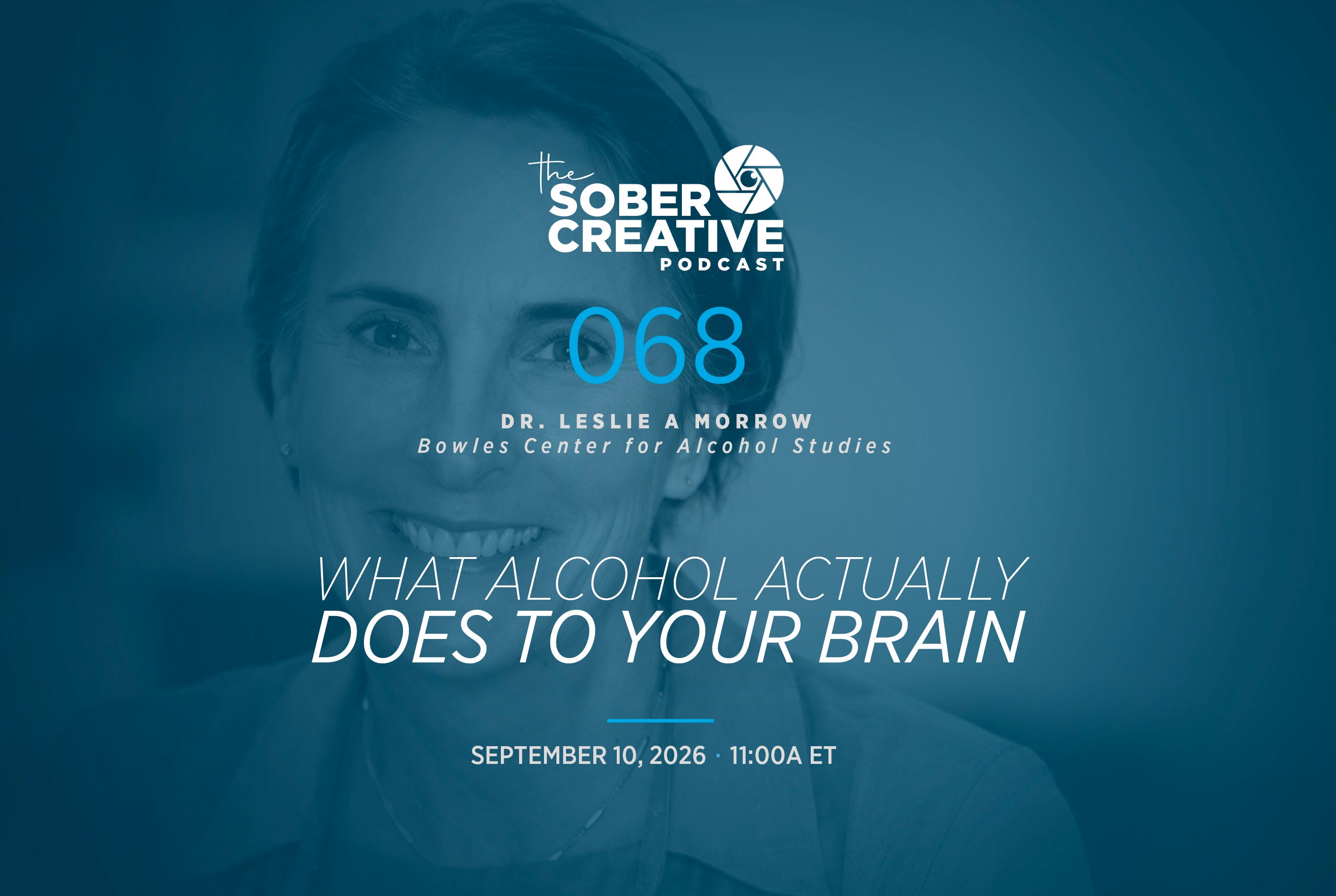
This week I’m sitting down with Dr. Leslie Morrow, a neuroscientist who spent 35 years at UNC’s Bowles Center for Alcohol Studies asking a question most of us only ever ask ourselves at 2am: What is alcohol actually doing in there?
She earned her PhD in neuroscience at UC San Diego in 1985, trained at NIMH, joined the UNC faculty in 1990, and published more than 238 papers on the way to a Lifetime Achievement Award from the Research Society on Alcohol.
Her discoveries around GABA-A receptors and the brain’s own pregnane neurosteroids helped open the door to clinical trials for alcohol use disorder and to brexanolone for depression.
I wanted her on the show because so much of what we call willpower is chemistry we were never taught to see. When you understand what the drink is doing to your stress system, your sleep, your inflammation, and your capacity to focus the next day, the decision to stop starts to feel less like deprivation and more like getting your equipment back.
What I’m Creating
Check out the note below. The piece I made in the first Clear Hour, forty minutes with a pen and no plan, plus what one member said about hers.
The next one is in October. If you want in, leave a comment or hit reply and I'll send you the date and the link directly.