


10 Pain Points of Sobriety is a weekly series where I explore the real pain points of quitting alcohol—the uncomfortable truths that surface when initial motivation fades. I didn’t need alcohol to be creative; creativity was already part of my life. Alcohol stole the time and energy I could have spent creating. It was my escape from feelings of inadequacy, from not being good enough, from trying to fit in. Five years into sobriety, I’ve learned that removing alcohol isn’t the end—it’s the beginning of becoming who you’re meant to be. Each week covers one pain point: the struggle, the truth no one mentions, and what actually helps.
The Pain
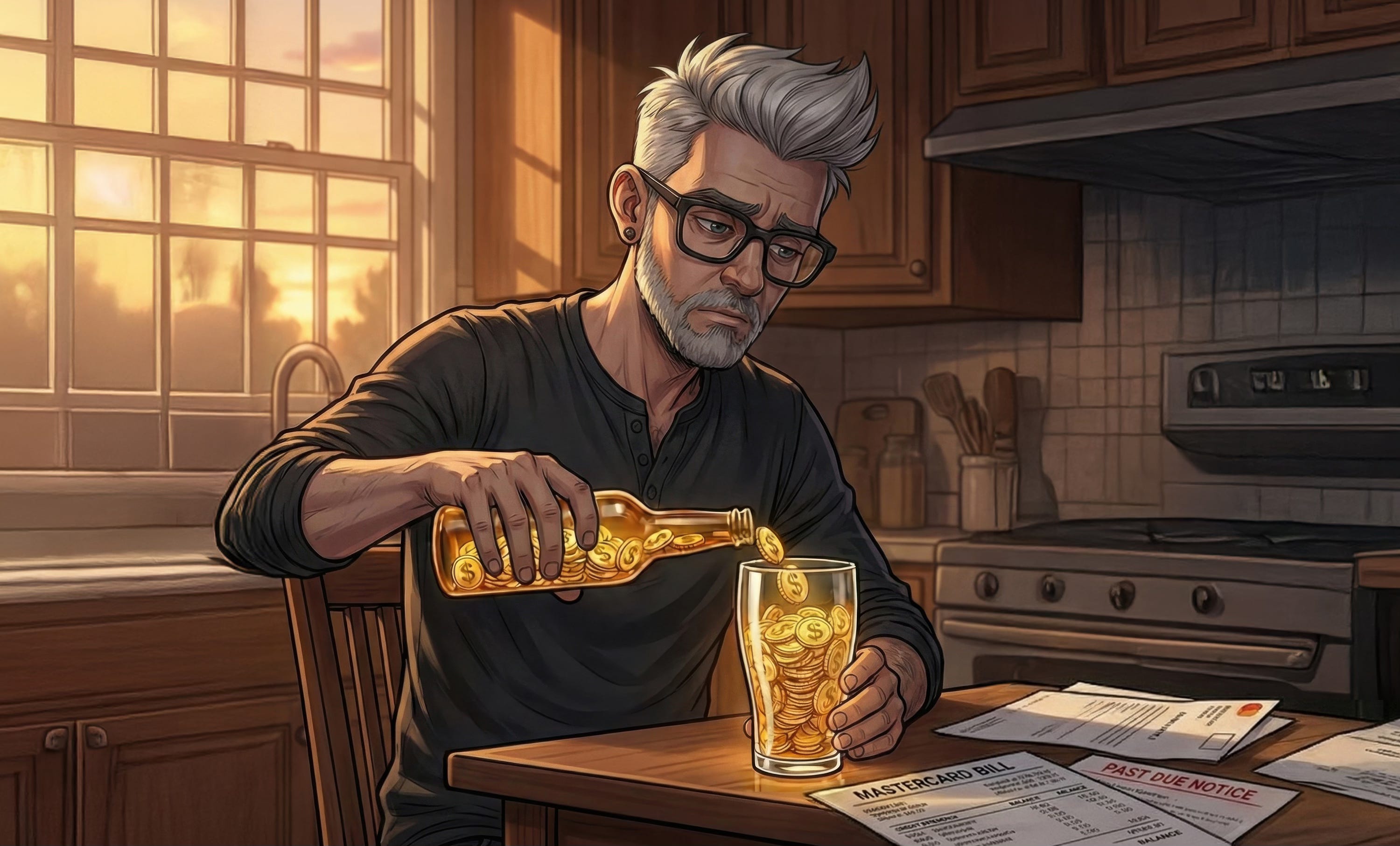
Staring. The cursor blinks next to the username. I know if I push this button I’m going to cringe at what I see. I hold my breath. Click. My eyes are closed. I take another breath and open them. Negative. My account is in the negative. Again.
Quitting drinking didn’t magically make my bank accounts positive. The bandaid was removed and I was forced to look at something I was avoiding for years.
As a creative running my own business, there’s constant fear and uncertainty around money. Not knowing when the next job is has been part of the process for twenty years. I’ve had lots of success and lots of stress. Even when things seemed bleak, I trusted the process and projects came in at just the right time.
But I stepped into this path with almost zero business training. Hard lessons came: managing everything myself, 0% credit cards stacking to six figures in debt, clients owing tens of thousands I’d never fully recover.
Financial distress became a major drinking trigger. The uncertainty around income and making payments—all of it fueled the drinking pattern and temporarily relieved the depression.
The worst part? Drinking was my escape from financial discomfort while simultaneously adding to the debt. I was avoiding my relationship with money entirely. A cycle that kept me seeing red.
The real pain is the lie you keep telling yourself: You’ll deal with it tomorrow. Next month will be different. Once this project comes through, once this payment hits, I’ll get back on track.
But tomorrow never comes when you keep hiding from the numbers.
I want to point out that with each of these pain points, the answers come from self-exploration. You have your own unique makeup, history, experiences, and habits that contribute to the desire to drink. What may work for you may not work for someone else. Adopting a state of curiosity, being willing to experiment, to practice, and ultimately commit to the process, will lead you more closely to the changes you wish to seek.
The Story
A few months into sobriety, I remember holding the scissors. I opened them and watched my other hand bring the piece of plastic to meet them. Over 20 credit cards laid out in front with a mountain of regret on top.
Some were maxed out. Some still had available credit—which was exactly the problem. Interest accruing. The option to transfer a balance, to buy myself another year of not dealing with it, was still there. And as long as that option existed, I’d keep taking it.
This was different though. Similar to how I was done with drinking, I wanted to be done with debt. I started cutting. The first one felt liberating. The second, that liberation grew. By the twentieth, I felt relief—not because the debt was gone, but because I’d finally stopped the bleeding. No more transfers. No more “just one more year.”
But the timing was brutal. I committed to abstinence in August 2020—right in the middle of COVID. Work had dried up because of this. The debt was already overwhelming, and now I had no income coming in. I started driving for Uber just to get by. There was no way I was going to pay off this credit card debt and sustain a living driving for Uber. My commitment was locked in though, there was no escaping through alcohol.
Now, I operate with only a personal and business debit card. This forced me to be more intentional. One of my coaches helped me through this process of developing a new relationship with money and he pushed me to use a budget app. It was hard at first, I opened it once, saw all of the numbers staring back at me, and closed it. I kept opening. Kept closing. This went on for weeks. I finally kept it open and I could look at the wound without immediately reaching for a drink to numb it.
The bandaid was off. The wound was there. But I wasn’t avoiding it anymore.
I started making calls to credit card companies. Negotiating payments. It still felt like a brick in my stomach—but I could sit with it now.
Each call, each payment, each month of not adding to the debt—it built resistance.
The Shift
The realization that came from building resistance—I couldn’t borrow anymore. Not from credit cards, not from future income, not from the fantasy that next month would be different. The money I was making—I had to be intentional with it. Just like my drinking habit, I’d been borrowing time. Time away from creating. Time away from facing reality.
Cutting up those cards forced me to turn inward. To face what I’d been avoiding.
A beautiful thing happened when I turned toward this fear, when I actually looked at it—it wasn’t as scary as I imagined. I saw the details. I started to understand the gaps. And when I understood this, I could work with it.
I started to appreciate what I already had instead of constantly focusing on what I didn’t. I desired stability. Real stability, not the illusion of it. And while that takes time and effort, that decision allowed me to move closer toward that goal.
The relationship shifted from avoidance to intention. Before sobriety, I’d spend because I had it (the illusion of credit), avoid seeing the interest balances, all while pretending the debt wasn’t growing. After, I looked at the numbers directly. Every dollar had a purpose. Decisions were made with pausing first. No more pretending.
Sobriety forced me to face my relationship with myself, including how I related to money. And by facing it, I could change it. Less financial stress meant better sleep. Better sleep meant more rest and more work. More work meant more income. Each piece supported the others, compounding in my favor.
Recently, I paid my car off. Getting in that vehicle and driving somewhere, knowing I own it—what an incredible feeling. Not just relief. Pride. Proof that facing the hard things actually works.
The Science
Financial avoidance isn’t just about not opening bills or checking your account. It’s a cognitive burden that never stops running in the background. You’re carrying the weight of what you refuse to look at, and that strain has real neurological costs.
Research shows that avoidance creates what psychologists call “cognitive load”—your brain is constantly working to keep threatening information suppressed. This drains mental resources you need for everything else: decision-making, creativity, focus. You’re spending energy on not-looking instead of problem-solving.
When you’re drinking regularly, this gets worse. Alcohol fundamentally impairs your executive function—the part of your brain responsible for planning, decision-making, and impulse control. Research shows that even moderate alcohol consumption increases financial risk-taking and reduces your ability to accurately assess long-term consequences.
You’re making financial decisions with a compromised brain. Not dramatic ones—subtle ones. Avoiding opening the bills. Not looking at the full picture. Refusing to add up the real numbers because seeing them might require action. Telling yourself it’ll all work out eventually, that next month will be different. Those aren’t rational assessments—they’re avoidance patterns reinforced by a prefrontal cortex weakened by chronic alcohol use.
And then there’s the stress cycle. Financial stress triggers cortisol release. Alcohol temporarily reduces cortisol, which is why it feels like it helps. But chronic alcohol use actually dysregulates your stress response system, making you more reactive to financial pressure, not less. A study in the National Library of Medicine found that:
“Prolonged excessive alcohol consumption produces ‘persistent dysregulation of brain reward and stress systems beyond normal homeostatic limits,’ contributing to increased anxiety during withdrawal.”
So you drink to manage money stress, but the drinking makes you worse at handling money, which creates more stress, which makes you drink more. The cycle compounds against you.
Sobriety breaks that cycle. Not because it magically makes you good with money, but because it gives you back the cognitive capacity to actually learn, to make plans, to follow through.
Over five years of sobriety, I estimate I’ve saved $25,000 to $40,000. That’s not just from not buying alcohol. That’s from not making drunk decisions. Not ordering delivery at 1 a.m. Not missing work because I’m too hungover to function. Not saying yes to things I can’t afford because my judgment is impaired. Not paying late fees because I avoided opening bills. The hidden costs add up faster than the visible ones.
When you finally face the numbers—when you stop avoiding and start looking—something counterintuitive happens. The initial spike in stress gives way to relief.
You’re no longer carrying the weight of what you refuse to see. You’re working with reality instead of running from it.
The Practice
For the next week, practice the 5-Minute Money Truth.
Set a timer for 5 minutes. Open a blank document or grab a piece of paper.
Write down three numbers:
How much you’re spending on essentials this month (or if you’re early in sobriety, estimate what you were spending on alcohol before you quit)
One bill or debt payment you’re worried about
One small financial win from this week (paid something off, said no to a purchase, made a call you’d been avoiding, anything)
That’s it. The first two might sting. The third one is your reminder that progress is happening. Don’t fix anything. Don’t make a plan. Just face the numbers—all of them.
Do this once a week. Same day, same time.
Over time, you’ll notice something shift. The numbers won’t trigger the same panic. You’re building a different relationship with money—one where looking becomes easier than avoiding.
Recovery starts with simply looking at the truth without shame. You can’t change what you won’t acknowledge. Five minutes of honesty builds the foundation for everything else.
This is how you turn financial strain into financial freedom. One honest look at a time.
You Don’t Have to Do This Alone
What You’re Feeling:
Sobriety isn’t just about saying no—it’s learning how to live without the false edge.
The quiet moments feel heavier. The creative spark feels unpredictable. You’re trying to rebuild trust in yourself, one decision at a time.
The Pattern:
You stay clear for a few days → energy returns → a moment of doubt hits → “maybe just one” → fog creeps back in → regret → restart.
Each cycle drains your belief that change is possible.
The Hidden Truth:
You’re not broken—you’re rebuilding your creative system. The fog isn’t proof you’ve failed; it’s evidence your body and mind are recalibrating toward clarity.
What This Costs You:
The energy that could power your next breakthrough
The focus that builds real momentum
The self-trust that turns ideas into finished work
The Path Forward:
Each week, I’m unpacking the real pain points of sobriety—the ones no one prepares you for—so you can navigate them with awareness, not avoidance.
Next week: Damaged Self-Worth (and how to trust yourself again).
Right now, you can find additional support here:
Take the free assessment → Find out if alcohol is blocking your creative potential (5 minutes).
Book a free call → Let’s design a plan that fits your creative process and the life you want to build.
The 31-Day Alcohol-Free Reset Starting January 1 is coming → Claim early bird pricing $29 and your spot below.
Regarding your point on financial strain, what if directly confronting precarity is the ultimate debugging proces for long-term personal growth?