


10 Pain Points of Sobriety is a weekly series where I explore the real pain points of quitting alcohol—the uncomfortable truths that surface when initial motivation fades. I didn’t need alcohol to be creative; creativity was already part of my life. Alcohol stole the time and energy I could have spent creating. It was my escape from feelings of inadequacy, from not being good enough, from trying to fit in. Five years into sobriety, I’ve learned that removing alcohol isn’t the end—it’s the beginning of becoming who you’re meant to be. Each week covers one pain point: the struggle, the truth no one mentions, and what actually helps.
The Pain
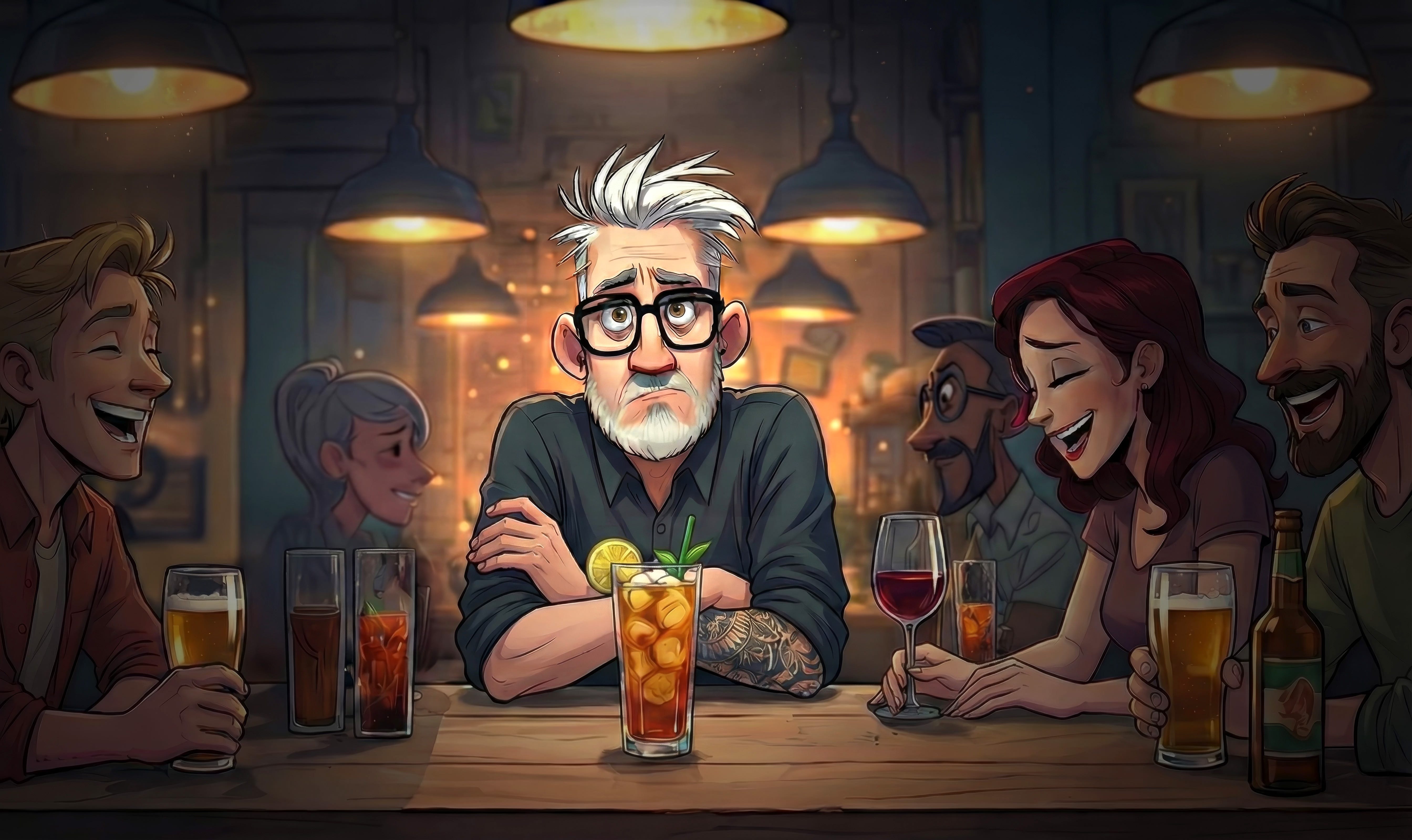
I look around the room. Moments of laughter and glasses clinking. The lighting is dim and sounds of conversations are molding together. A woman dressed in apron attire and a notepad comes to the table. One of the guests says, “What is your favorite wine?” The next person doesn’t hesitate, “I’ll have the local IPA.”
The waitress steps up to me. “And for you?” I pause briefly. “Iced-tea, unsweet.”
There’s a second that feels like a lifetime. It’s subtle, but you feel it. Someone shifts in their seat. Another person glances at their phone. Your friend across from you—the one who’s known you the longest—gives you that look. The one that says wait, you’re not drinking?
Then it starts.
“Come on, just have one.”
“Don’t make me drink alone.”
“When are you going to be done with this?”
These questions create so much pressure. Because now you’re not just dealing with your own decision—you’re responsible for how they feel about it. And suddenly you’re drowning in guilt. If you hold your ground, you’re making them uncomfortable. If you give in, you’ll wake up tomorrow hating yourself for breaking the promise you made.
Either way, you lose.
This isn’t a one-time thing. It’s every dinner. Every work event. Every birthday, wedding, holiday gathering, sporting events, brunch, music venues, run clubs, singles mixers—the list is endless. And at every single one, alcohol isn’t just present. It’s the centerpiece. The shared experience. The thing that’s supposed to make it all more fun, more loose, more connected.
Except now you’re on the outside of the fishbowl. And it feels like you’re breaking some unspoken chain. Like you’re the one making it weird by not drinking. And maybe you are. Because when you say no, the dynamic shifts. People drink less around you, or they apologize for drinking, or they just seem… different. And you can’t tell if they’re uncomfortable or if you’re just projecting, but either way it’s fucking exhausting.
You start avoiding things. Making excuses. Suddenly you’re “busy” a lot. Because it’s easier to be alone than to sit through another round of questions you don’t have the energy to answer.
“How’s that going for you?”
“When can you drink again?”
“Are you ever going to be normal?”
And the worst part? You start to wonder if they’re right. Maybe this is too hard. Maybe you’re being too rigid, too serious, too much. Maybe one drink wouldn’t hurt. Maybe you could just have one and make everyone comfortable again and stop being the person who makes everything awkward.
So you do. You have the drink. And for a few hours, it works. Everyone relaxes. You relax. It feels like it used to.
Then you wake up the next morning and feel it again. The blanket covering you is wrapped in guilt and shame. You didn’t just disappoint them. You broke the trust with yourself. And that feeling—that exhaustion of fighting yourself, fighting them, fighting the endless cycle of trying to make everyone comfortable while slowly disappearing—that’s the pain.
You’re isolated either way. Alone in the room full of people, or alone at home avoiding them altogether.
I want to point out that with each of these pain points, the answers come from self-exploration. You have your own unique makeup, history, experiences, and habits that contribute to the desire to drink. What may work for you may not work for someone else. Adopting a state of curiosity, being willing to experiment, to practice, and ultimately commit to the process, will lead you more closely to the changes you wish to seek.
The Story
The blue circle pops up on my screen.
A text from a friend. “We are having a get together tonight, want to come?”
I stare at it. My stomach sinks immediately. I’m already playing every scenario in my head—what people will think when I’m not drinking, what they’ll say, how I’ll act, how I’ll respond. All these different thoughts spiraling at once.
It’s a tug of war. Part of me wants to go. Part of me knows what happens if I do.
I type back: “Can’t make it tonight. Thank you for the invite though, maybe next week.”
I lock my phone and set it face down on the table.
This was the pattern. Every invitation was a decision. Go or avoid. And at first, I avoided everything.
Not because I didn’t want to see people. But because the temptation was so strong at the beginning that it felt necessary to just say no. To isolate completely. Because I knew—most likely it would be a good time. But I’d be the only one not drinking. And I wasn’t ready for that.
So I stayed home. A lot.
And in that isolation, something unexpected happened. I had time. Time alone. Time that forced me to develop a deeper relationship with myself.
I started changing my relationship with sleep. I’d always told myself I was terrible at it and the pattern was already there from drinking—staying up late, waking up exhausted and hung over. But now, without alcohol, I was forcing myself to go to bed earlier. And I was waking up earlier too. Not because I had to. Because I could.
The isolation also gave me space to evaluate my friendships. To really look at which ones were built around drinking and which ones weren’t.
Some friendships, I realized, only existed around alcohol. The time we spent together was only in that environment. And when drinking was the focus, it didn’t feel like there was an option to be in that space and not drink and still have a good time. It just didn’t work.
I had to grieve that. The loss of what those friendships were. Not because they were bad or wrong, but because they didn’t fit anymore.
But that grief opened something up.
More time for my work. New relationships that weren’t built around drinking. Different types of social activities I’d never considered before. And more creative time—not just because I wasn’t dealing with hangovers, but because my creativity was sharper. Clearer. More alive.
The isolation forced me to focus on myself. My health. My wellbeing. And in doing that, I started to build something I didn’t have before: confidence.
The belief that I could show up as myself—go out, not have a drink, and enjoy it even more than when I was drinking.
The isolation wasn’t punishment. It was preparation.
The Shift
There’s a period in early sobriety where I had to be selfish. And that was 100% okay. I was building this new relationship with myself, and that’s what mattered most during that time.
The isolation wasn’t about punishing myself or hiding from the world. It was about finally listening to the thoughts I’d been drowning out for years.
And those thoughts? They were loud.
I’m not interesting without a drink.
No one is going to like me when I’m sober.
I’m not enough.
These thoughts kept me drinking in the first place. The inadequacy. The feeling that I didn’t fit in. That I needed something outside of myself to be acceptable.
But this is the exact reason why social isolation is important.
Because once I became aware of my thoughts—especially the negative ones—I could shift that narrative. I could change the relationship with myself. I could become more loving toward myself. I could forgive myself.
Something shifted as well with my friends.
The ones I used to drink with started to accept I didn’t drink anymore. Something that came as a bit of a surprise: it wasn’t as big of a deal as I thought. The dinners still happened. The conversations still flowed. But now the focus was on the food. The stories. The connection. It was deeper than when alcohol was the centerpiece.
I was still there. Still invited. Still part of it. But now I was more myself than I’d ever been when I was drinking.
When I rebuilt the connection with myself, I gained the confidence to be put in any situation. I wasn’t worried about what people thought. I wasn’t performing. I was just… there. Fully present. Fully myself.
The isolation wasn’t about losing people. It was about finding myself. And once I did, I realized the confidence was never missing. It was just buried under years of trying to be someone else.
The Science
Your brain has a natural system for making you feel connected to people. It’s called oxytocin—sometimes it’s referred to as the “love hormone.” When you genuinely connect with someone, your brain releases oxytocin. It makes you feel safe, trusted, bonded.
Alcohol does something sneaky: it creates those same feelings without you actually having to connect with anyone. Your brain thinks you’re bonding, but you’re not. It’s fake connection.
As researchers from the University of Birmingham found,
“Alcohol and oxytocin appear to target different receptors within the brain, but cause common actions on GABA transmission in the prefrontal cortex and the limbic structures. These neural circuits control how we perceive stress or anxiety, especially in social situations.”
That’s why drinking feels like it makes socializing easier. It’s not that you’re more interesting or funnier—alcohol is just triggering the “connection” feeling in your brain artificially.
This is why social situations feel so uncomfortable when you first stop drinking. Your brain has been relying on a chemical shortcut for bonding.
When you remove that shortcut, you’re left with raw social anxiety—the very thing alcohol was masking.
When you step away from social situations during early sobriety, you’re giving your brain time to recalibrate. The isolation allows you to rebuild confidence through aligned action. Each time you keep a promise to yourself—going to bed earlier, declining an invitation, sitting with uncomfortable thoughts—you’re building self-trust.
Your brain is literally rewiring itself to find reward in authentic connection.
The discomfort of isolation isn’t a sign you’re failing. It’s evidence your brain is learning to connect without your friend in the bottle.
The Practice
For the next five days, spend ten minutes each day on isolation work. Each day has a different focus, working through the key areas that rebuild your relationship with yourself and others.
Day 1: Self-Talk
Sit with your thoughts for 10 minutes. Write down the negative narratives that come up when you think about socializing sober. I’m not interesting without a drink. No one will like me. I’m boring.
For each negative thought, write one counter-narrative based on evidence. What’s actually true?
Day 2: Friendship Audit
Pick one friendship. Write honestly: Is alcohol central to this relationship? Does this person support my sobriety? Do I feel like myself around them?
You’re not making decisions yet—just gathering information.
Day 3: Boundary Practice
Write out three simple responses to social pressure:
“I’m not drinking tonight.”
“I’m good with water.”
“I’m taking a break from alcohol.”
Say them out loud. Practice until they feel natural, not defensive.
Day 4: Solo Activity
Do one thing alone that you’d normally do socially. Get coffee. Sit at a restaurant. Take a walk through a busy area.
Notice how it feels. You’re building comfort being alone in public.
Day 5: Reflect
Look back at the week. What did you learn about your thoughts? About your friendships? About yourself?
Write down one thing that shifted.
By the end of five days, you’ll have a clearer picture of which thoughts need shifting, which friendships serve you, and how capable you are of being alone.
This is how you use isolation intentionally. One day at a time.
You Don’t Have to Do This Alone
What You’re Feeling:
Sobriety isn’t just about saying no—it’s learning how to live without the false edge.
The quiet moments feel heavier. The creative spark feels unpredictable. You’re trying to rebuild trust in yourself, one decision at a time.
The Pattern:
You stay clear for a few days → energy returns → a moment of doubt hits → “maybe just one” → fog creeps back in → regret → restart.
Each cycle drains your belief that change is possible.
The Hidden Truth:
You’re not broken—you’re rebuilding your creative system. The fog isn’t proof you’ve failed; it’s evidence your body and mind are recalibrating toward clarity.
What This Costs You:
The energy that could power your next breakthrough
The focus that builds real momentum
The self-trust that turns ideas into finished work
The Path Forward:
Each week, I’m unpacking the real pain points of sobriety—the ones no one prepares you for—so you can navigate them with awareness, not avoidance.
Next week: Physical Recovery (and the strength you didn’t know was possible).
Right now, you can find additional support here:
Take the free assessment → Find out if alcohol is blocking your creative potential (5 minutes).
Book a free call → Let’s design a plan that fits your creative process and the life you want to build.
The 30-Day Alcohol-Free Reset Starting January 1 is coming → Be the first to know when doors open on December 1.
Hi Josh. I think your description of your journey is really interesting. You are articulating each nuance of the transition so well. I quit in 2024 - just decided one day as part of a long line strategy to increase my chances of being healthy in later life. I experienced many of the situations, feelings and emotions you describe. The biggest realisation for me was who am I - who is the me who doesn't drink and started trying to reconnect with myself. Keep going, I wish you every success.