


10 Pain Points of Sobriety is a weekly series where I explore the real pain points of quitting alcohol—the uncomfortable truths that surface when initial motivation fades. I didn’t need alcohol to be creative; creativity was already part of my life. Alcohol stole the time and energy I could have spent creating. It was my escape from feelings of inadequacy, from not being good enough, from trying to fit in. Five years into sobriety, I’ve learned that removing alcohol isn’t the end—it’s the beginning of becoming who you’re meant to be. Each week covers one pain point: the struggle, the truth no one mentions, and what actually helps.
The Pain
Imagine you’re falling. You can’t grab onto anything. Fear pulses through your veins. Your heart beats rapidly. You don’t know when or if you’ll land.
Your eyes open. “I’m not going to drink today.”
There’s a sense of safety when we feel like we’re in control. That, if I can control my drinking, then my life feels in order. Other people will see I’ve got my shit together. They won’t think I’m incapable of managing my life.
And in creative work, you believe there’s only one way to show up - polished, put-together, where no one sees how messy it really is.
This desire for control comes from wanting to appear capable. But the pressure of maintaining that image - of being polished, of having it together - creates stress. And then to manage that stress, you drink. Which creates the exact loss of control you were trying to avoid.
So how do you avoid this loss of control?
You try harder. You make stronger promises. You’re only going to drink on the weekends, only one every couple of days, only once a week; you find countless ways to make it seem like you are in control.
All of these ways represent the illusion of control. I’ll give you the truth. It was never about control.
Your subconscious is more powerful than the thought of what you will do in the moment. You can promise yourself in the morning that you’ll only have one. By 5 o’clock, that promise dissolves. One turns to two. Two turns to three. Days or drinks. You know the pattern.
Each failed attempt at control becomes more evidence that you’re incapable. The pressure doesn’t just threaten your sobriety—it threatens your belief that change is even possible. And it steals the time and energy you could be spending on building your creative potential.
I want to point out that with each of these pain points, the answers come from self-exploration. You have your own unique makeup, history, experiences, and habits that contribute to the desire to drink. What may work for you may not work for someone else. Adopting a state of curiosity, being willing to experiment, to practice, and ultimately commit to the process, will lead you more closely to the changes you wish to seek.
The Story
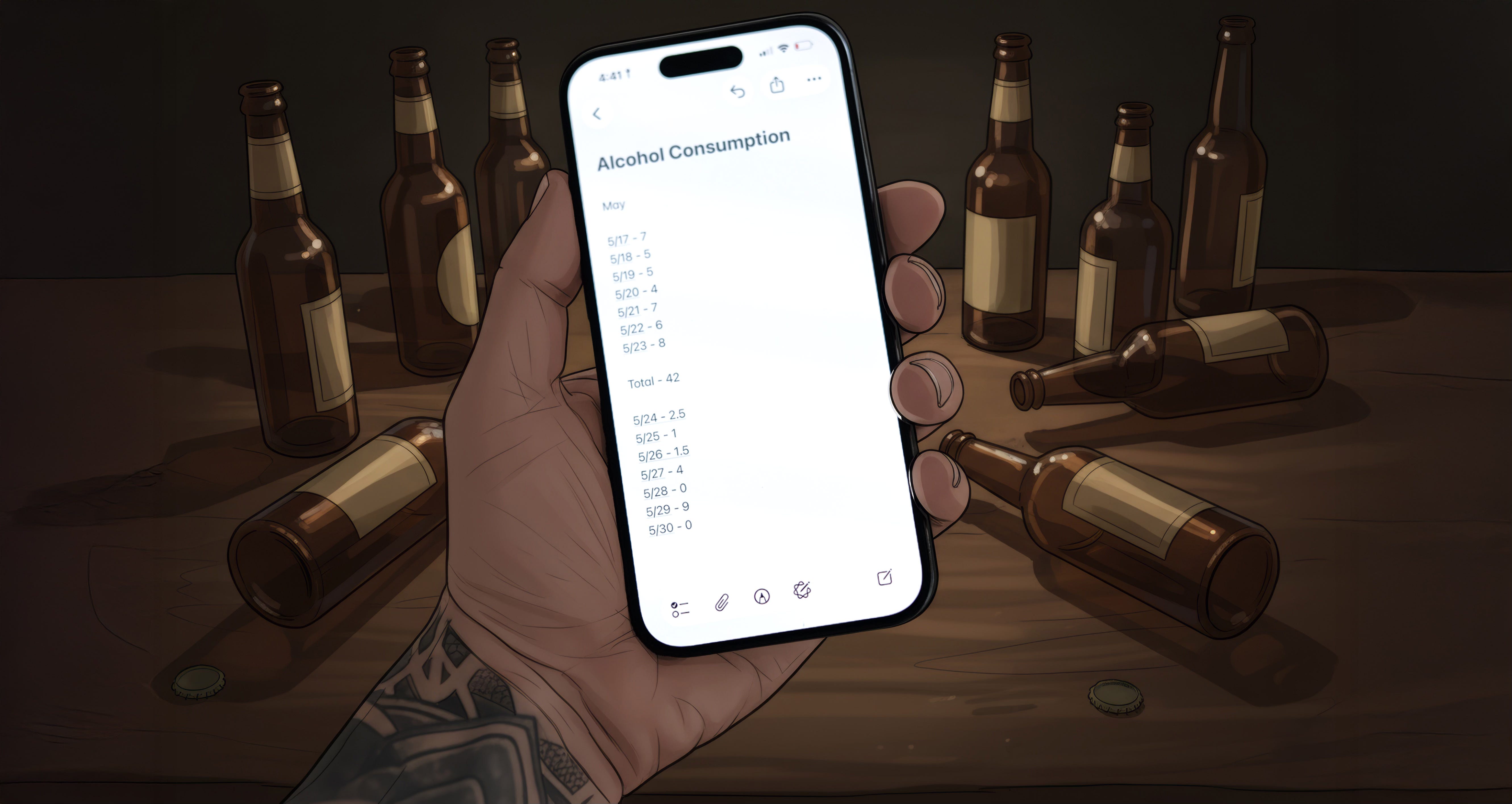
Floating through the space of darkness, the subtle sounds of chimes are echoing in the distance. They grow louder. My hands reach over, fumbling for my phone. I touch the screen and enter the number 8 next to Thursday. As my head pounds, I tell myself, “Today is going to be different, I’m not going to drink.”
I was in a relapse cycle for 2 years. I tried to control how much I would drink. I created a tracking system in my notes app. I did this for months, trying to find patterns. Days, weeks, looking for anything.
I built Excel spreadsheets. I thought if I could visually see where the gaps were, then maybe I could change. Maybe I could figure out a way to be in control. I would do okay for a few days without any, then I’d swing into a few big days, looking like this - 0, 3, 1, 8, 7, 2, 5, 0 - every week looked entirely different. Reality was, I couldn’t find a single pattern that I felt was worth anything. The feeling of failure seemed to be growing with each day I would slip back.
Even though there was disappointment in entering the data around having a drink, it was still motivation to keep showing up. To keep trying. Deep down, I knew I wanted to change, and somehow I would find a way.
I remember staring at those spreadsheets, all that data, all that effort to be the one in control. The frustration sat heavy in my stomach most of the time. It wasn’t about the amount. It wasn’t about the patterns. It wasn’t about the control. It was about something I couldn’t ever imagine doing.
The Shift
But that realization didn’t come from nowhere. The seed was planted three years earlier.
In the summer of 2017, I stepped into a dark room filled with orange neon lights, rows of rowing machines, treadmills, free weights and kettlebells. I had been going to Orange Theory Fitness regularly, and one day, my coach Mike noticed me struggling while trying to run my fastest on a treadmill segment.
While I’m leaning over catching my breath and everyone else is still sprinting, he comes up next to me. “What’s going on?” he asks. I tell him, “I drank a lot last night so I’m having a hard time.” He nods slowly and says, “You’re not going to progress if you keep drinking like that.”
That was the whisper.
I wanted to progress. I wanted health and vitality. I wanted to be stronger, have more endurance, and perform better in my personal and creative field. But I couldn’t have both—alcohol and progress. The choice was clear, even if it took me two more years of trying to control it before I fully accepted what Mike had said.
Each time I tried to stop during those two years, each time I relapsed, these moments were teaching me something. They were providing me information. They were opportunities to learn. Relapsing didn’t mean failure. It meant: what part of my life, my experience, am I not paying attention to?
Life doesn’t give you control. All of the thoughts, situations, moments impact the decision I will make later. I could make a decision now and in five minutes have a completely different feeling around it. Relapse is one moment, one thought, one decision, one choice away.
I wasn’t ever going to be in control of my drinking. That acceptance—that full surrender of the illusion—changed everything.
On August 19, 2020, I committed publicly to one year of abstinence. No more tracking. No more spreadsheets. No more trying to manage the unmanageable. Just one clear number: 0.
From what I can remember, the first week or few days was exciting. The adrenaline was there. I was finally going to do it. As the days progressed, I kept waiting for the familiar internal negotiation to start—“should I have one tonight?”—but I’d already removed that option. The decision was made. There was nothing to control anymore.
What I noticed instead: the space that opened up. The evenings I used to spend drinking, I spent more time on creative projects. The mornings I used to spend recovering, I spent at the gym, actually making progress on the strength and endurance I wanted.
The practices I’d already been doing—meditation, fitness, sleep—became easier to maintain because I wasn’t disrupting them every few days with alcohol. Each one reinforced the others. Better sleep supported better workouts. Better workouts created better mental clarity. Better mental clarity strengthened my commitment.
Within a few months, something shifted. I stopped thinking about alcohol as something I was avoiding. It simply wasn’t part of my life anymore. The grip loosened because I wasn’t afraid of letting go.
The Science
When people talk about “losing control” with alcohol, it’s not a personal failure—it’s neurological. Let’s look at how loss of control happens in two stages.
Stage 1: Before the first drink
Your subconscious mind processes emotional cues and stress signals faster than your rational brain can intervene. Research shows that decisions to drink are often made unconsciously, driven by learned associations and emotional triggers, before your conscious mind even registers the choice. This is why your morning promise to have “just one” dissolves by 5 o’clock—your subconscious has already decided based on stress, habit, or emotional state.
Stage 2: After the first drink
Once alcohol enters your system, it suppresses the prefrontal cortex—the region responsible for impulse control, decision-making, emotional regulation, and long-term thinking. As the National Institute on Alcohol Abuse and Alcoholism states,
“Alcohol disrupts function in the prefrontal cortical areas involved in executive function, impulse control, decision‐making, and emotional regulation.”
This is why “just one” becomes six. The very part of your brain that would help you stop is now compromised. You’re not weak—your conditioning is working against you at two different levels.
The paradox of control becomes clear: your subconscious decides to drink before your conscious mind can stop it, and then alcohol suppresses the brain function that could help you moderate. You’re asking your prefrontal cortex to regulate something that’s being driven by your subconscious and then actively disrupting your prefrontal cortex.
Acceptance isn’t giving up. It’s recognizing that control was never the right tool for this job. When you stop fighting for control and commit to complete abstinence, you remove the substance that’s been hijacking your decision-making capacity at both levels. You give your brain—conscious and subconscious—space to heal and rebuild the neural pathways that support genuine choice.
This is why a full stop works when moderation doesn’t. You’re not trying to manage something that undermines your ability to manage it. You’re stepping out of the paradox entirely.
The Practice
For the next seven days, let go of trying to control your drinking. Instead, commit to observation.
Write down this statement: “For seven days, I’m letting go of control. I will not drink, and I will simply observe what happens.”
Read it every morning. This isn’t a promise you might break—it’s a commitment you’ve already made. You’re not negotiating whether to drink today. You’ve already decided for these seven days.
Throughout each day, track two things:
1. How you’re feeling (rate each day on a scale):
🌈 Very Easy (expansive, energized)
💡 Easy-Light (manageable, clear)
⛅ Okay (neutral, steady)
🌧️ Hard-Heavy (struggling, tempted)
🥊 Very Hard (strong cravings)
2. What you notice
Get a journal. When a craving comes up, write down what happened right before it started.
By day seven, you’ll have a visual map of your week. You’ll see patterns you couldn’t see while you were fighting for control. The hard days will show you what needs attention. The easier days will show you what’s working.
This practice does two things: it removes the exhausting daily negotiation with yourself, and it gives you concrete data that starts to reveal insights about your relationship with alcohol that no amount of trying to control could provide.
This is how you release control. One day at a time.
You Don’t Have to Do This Alone
What You’re Feeling:
Sobriety isn’t just about saying no—it’s learning how to live without the false edge.
The quiet moments feel heavier. The creative spark feels unpredictable. You’re trying to rebuild trust in yourself, one decision at a time.
The Pattern:
You stay clear for a few days → energy returns → a moment of doubt hits → “maybe just one” → fog creeps back in → regret → restart.
Each cycle drains your belief that change is possible.
The Hidden Truth:
You’re not broken—you’re rebuilding your creative system. The fog isn’t proof you’ve failed; it’s evidence your body and mind are recalibrating toward clarity.
What This Costs You:
The energy that could power your next breakthrough
The focus that builds real momentum
The self-trust that turns ideas into finished work
The Path Forward:
Each week, I’m unpacking the real pain points of sobriety—the ones no one prepares you for—so you can navigate them with awareness, not avoidance.
Next week: Social Isolation (and why it’s preparation, not punishment).
Right now, you can find additional support here:
Take the free assessment → Find out if alcohol is blocking your creative potential (5 minutes).
Book a free call → Let’s design a plan that fits your creative process and the life you want to build.
Everything else—the essays, podcast, meditations—is here when you’re ready.
But start with one of those two. That’s how the shift begins.