


10 Pain Points of Sobriety is a weekly series where I explore the real pain points of quitting alcohol—the uncomfortable truths that surface when initial motivation fades. I didn’t need alcohol to be creative; creativity was already part of my life. Alcohol stole the time and energy I could have spent creating. It was my escape from feelings of inadequacy, from not being good enough, from trying to fit in. Five years into sobriety, I’ve learned that removing alcohol isn’t the end—it’s the beginning of becoming who you’re meant to be. Each week covers one pain point: the struggle, the truth no one mentions, and what actually helps.
The Pain
I open my eyes. I breathe. It’s day 1. I didn’t have any alcohol last night. I feel good. I feel great, actually. My mood and spirits are high. I’m getting things done. I’m ready to create. Problems are coming at me and I’m managing them without any issues. I go to sleep thinking, “Maybe this whole quitting process isn’t that hard after all.”
It’s the end of day 3 and I’m experiencing that familiar warm, numbing feeling running through my whole body. This is after I downed my sixth beer. I relapsed and the shame feels as though I was smacked in the face with a sledgehammer. There goes another day I could have been creating, replaced by managing a hangover while the dark clouds of regret float above.
What do you do when day 3 hits and the temptation becomes overwhelming?
Your body and mind are so used to having alcohol in its system. Taking it away is one of the hardest things to do. If you haven’t developed a practice to replace drinking with something else, the percentage of relapsing is much higher. The challenging part is you’ve gathered up so much strength to actually commit to stop drinking, you do it and then you slip, the guilt adds so much more pressure, you start to believe you are incapable of achieving sobriety. And so you give up. You’re back in your old patterns and you solidify this false belief you are incapable of doing it.
This is normal. Yes, you heard me. You are normal. There is nothing wrong with you.
What happens when you’re walking down the road and you trip? You stumble and fall, maybe you pause for a moment and look around, hoping no one saw. Here’s what you don’t do: you don’t stay in the middle of the street and decide you’ll never get up and walk again. You get up and you keep walking.
Sobriety works the same way.
I want to point out that with each of these pain points, the answers come from self-exploration. You have your own unique makeup, history, experiences, and habits that contribute to the desire to drink. What may work for you may not work for someone else. Adopting a state of curiosity, being willing to experiment, to practice, and ultimately commit to the process, will lead you more closely to the changes you wish to seek.
The Story
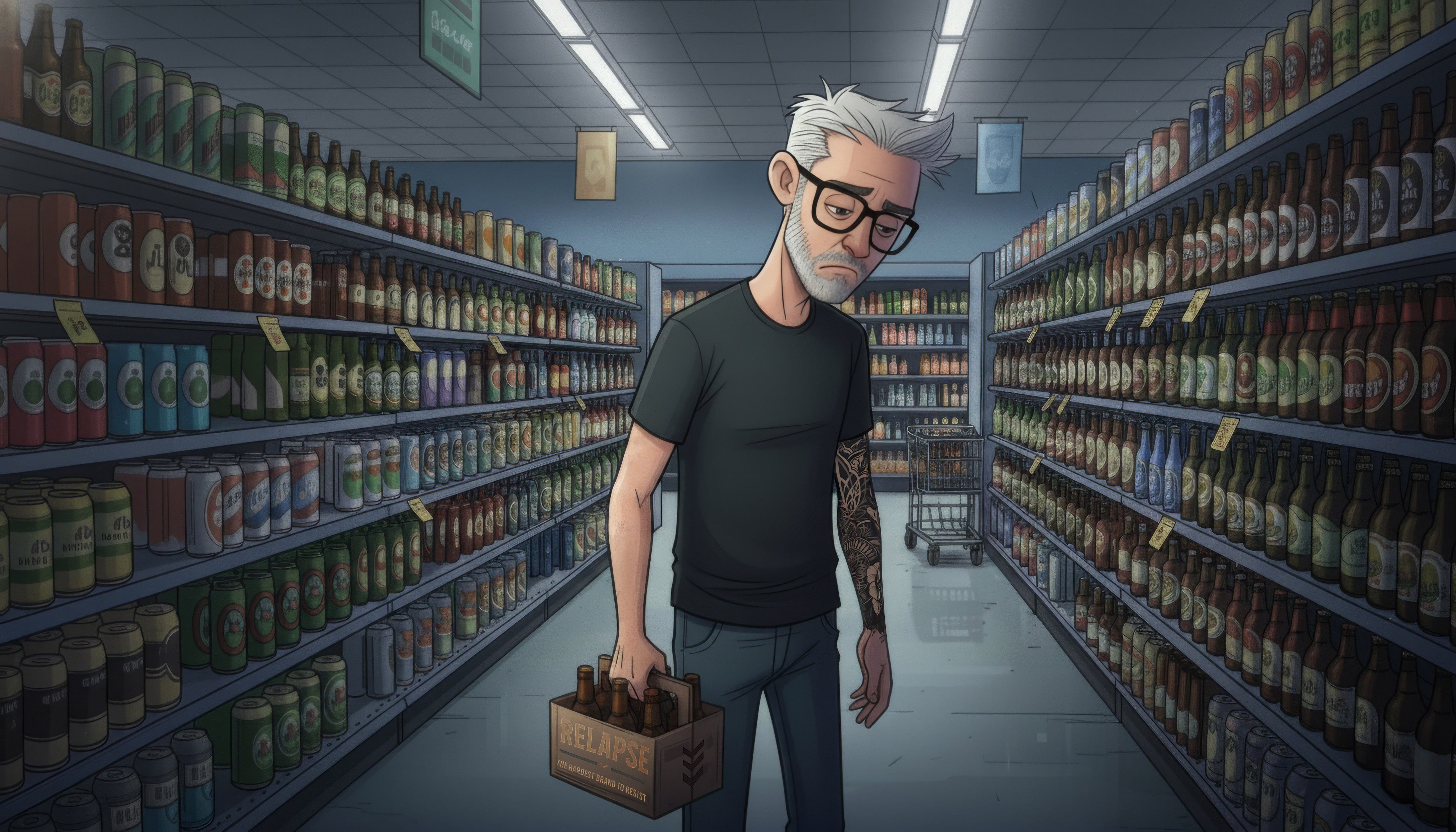
There’s a familiar feeling happening in my stomach. A deep, undesirable heaviness. My breath is shallow and my skin shivers. I stare down the giant wall of the colorful branded microbrew packaging, about to make a decision I will yet again, regret. Shame builds rapidly inside my body, the craving to get rid of this feeling is too strong. I grab the six-pack and painfully accept I have lost another round to relapse. Alcohol continues to beat me at my own game.
When the desire to stop drinking became strong enough to take action, quitting didn’t happen overnight. I can’t count on my hands how many micro-relapses I experienced during this time. I would look for patterns to see if I could control it (more on this next week). That didn’t work. Relapses kept happening.
Drinking wasn’t something I did for fun. Drinking was something I did to mask the pain I didn’t want to feel. When I finally stopped, that heaviness in my stomach, that shallow breath—it was all still there. I just didn’t have my escape route anymore.
Each relapse felt like proof I was broken. That I couldn’t do this. But what I learned, now five years into sobriety, is willpower alone is not enough. Commitment alone is not enough. Building that resistance—until you don’t even desire it anymore—requires willingness to practice in other areas of your life.
The Shift
After all those micro-relapses, I needed something bigger than trying to do it on my own. The public commitment in August 2020 to abstain for a year removed the option to quietly slip back. I couldn’t experiment with “just one beer” anymore—everyone would know. That accountability forced me to find actual substitutes.
Athletic Brew became my savior in those early weeks. The taste was just as good, if not better, than real beer. I’d stand in the same grocery store aisle, looking at the different IPAs I used to buy, knowing the NA section was just steps away. My body would feel a sense of relief—I had an option that didn’t require me to leave empty-handed or break my commitment.
I could still cheers with friends, still hold a beer in my hand at social gatherings. It was a win that didn’t cost me my sobriety.
But there were harder moments too. I remember sitting in a restaurant on a trip, staring at the beer menu. I felt a subtle pull toward what was on there, a sense of loss for what I was giving up. The past on one side, the future on the other. Commitment was standing in the middle.
That’s when I started to truly understand what it meant to say no—not through gritted teeth and willpower, but through something I was actively building toward.
I leaned harder into the meditation practice I’d been doing since 2014. I got more intentional about sleep, about exercise, about the practices I already knew worked but hadn’t been fully committed to. Each one reinforced the others, creating a foundation strong enough that alcohol lost its appeal entirely.
I’m unable to come up with one reason why I would want alcohol in my life. That’s been the biggest shift. I’m not disregarding its effects or making excuses. I know there are no benefits.
The Science
When your body or mind enters a state of stress, the natural tendency is to reach for comfort. That’s why alcohol is so accessible—it’s the quick fix. You’ll often hear people say alcoholism is a disease. I prefer viewing it as a moment of dis-ease. Your natural state, your flow, gets disrupted, and you enter discomfort.
Research across multiple studies points to stress-related events and environmental, social, or internal cues tied to past drinking as major triggers for craving and relapse.
A 2022 study found that “emotional distress, endocrine and autonomic stress reactivity, impulsivity, attentional bias and craving account for most of the effect of stress on alcohol use in risky drinkers.” From Underlying mechanisms in the relationship between stress and alcohol use – Wittgens C. et al. (2022)
How you counter relapse is through the work you do in sobriety. The first step is to stop drinking—this disrupts the pattern. The next step is developing practices that support you in handling stress in a much more healthy, constructive way.
The Practice
When the urge to drink hits, this is your opportunity. Move your body for ten minutes.
Go for a walk around the block. Do pushups in your living room. Put on music and dance. Anything that gets your body moving and your heart rate up. No app needed, no gym required—just you and movement.
Movement does two things: it interrupts the craving in real time by shifting your physical state, and it releases the same dopamine your brain is searching for in alcohol. You’re not resisting the urge through willpower—you’re giving your nervous system what it actually needs.
Do this every single day for a week. Not just when cravings hit, but as a daily practice. Morning, afternoon, evening—whatever time works. Ten minutes. The consistency matters more than the intensity.
By the end of the week, you’ll notice a shift: the urges begin to soften. Your body starts to trust that it can get what it needs without alcohol. You’re building a new pathway, one that actually serves you.
This is how you break the relapse cycle. One movement at a time.
You Don’t Have to Do This Alone
What You’re Feeling:
Sobriety isn’t just about saying no—it’s learning how to live without the false edge.
The quiet moments feel heavier. The creative spark feels unpredictable. You’re trying to rebuild trust in yourself, one decision at a time.
The Pattern:
You stay clear for a few days → energy returns → a moment of doubt hits → “maybe just one” → fog creeps back in → regret → restart.
Each cycle drains your belief that change is possible.
The Hidden Truth:
You’re not broken—you’re rebuilding your creative system. The fog isn’t proof you’ve failed; it’s evidence your body and mind are recalibrating toward clarity.
What This Costs You:
The energy that could power your next breakthrough
The focus that builds real momentum
The self-trust that turns ideas into finished work
The Path Forward:
Each week, I’m unpacking the real pain points of sobriety—the ones no one prepares you for—so you can navigate them with awareness, not avoidance.
Next week: Lost Control (and how it was never about control to begin with).
Right now, you have two options:
1. Take the free assessment → Find out if alcohol is blocking your creative potential (5 minutes).
Book a free call → Let’s design a plan that fits your creative process and the life you want to build.
Everything else—the essays, podcast, meditations—is here when you’re ready.
But start with one of those two. That’s how the shift begins.