


✨Weekly Insight
Your body has always known.
Before you could name what was wrong, it knew. The tight chest. The bad sleep. The low hum of something being off. You felt it. You just learned to reach for something that would turn the volume down.
But the signal was never the problem. It’s the choice that followed it that created one.
Grief is supposed to feel like grief. Anxiety is supposed to feel uncomfortable. The body isn’t malfunctioning when it hurts — it’s working. It’s trying to move you somewhere.
The hard feelings pass when you let them be what they are. You don’t have to fix them or solve them or explain them. You just have to stay.
And when you start trying to think your way out of the problem, you end up creating more problems when you could just stop thinking.
Thoughts happen, thinking is a choice. You can choose to let go.
The wisdom in you is older than your habits. It was there before the version of you that needed to escape.
It’s still there.
🎙️Clear Conversations: Creative Minds in Sobriety
She Was Never Sober. Then She Was Done with Everything.
Shelly grew up surrounded by cars. Her whole family was into them. She wasn’t. She played clarinet — first chair bass clarinet, nationals, all-county. That was her world.
Then she got her first car. A tech told her she needed a long list of repairs. Her dad and brother looked at it and said she didn’t need any of that. After her brother fixed the two things that actually needed fixing, something shifted. She decided nobody else was ever touching her car again. She was going to learn how to do it herself.
She became a mechanic. The only woman in the shop for most of it. She cycled through brands — worked at just about every dealership you can name — trying to find an environment where she actually belonged. At a couple of those shops, there were other women. She’d try to connect. It would start fine, and then at some point, without explanation, those women would stop letting her in. She still doesn’t know why. She stopped trying to figure it out and just moved on.
Meanwhile, she’d been smoking weed since she was 15. The automotive world doesn’t drug test. By the end, she was smoking from the moment she woke up until the moment she went to bed, working or not. It got to where she was never really in a clear headspace. And she felt alone in a way that was hard to name — not without people exactly, but without the right ones. She was using all of it to keep telling herself: keep going, doesn’t matter, keep going.
At some point she stopped believing that.
Three and a half years ago, she quit everything at once. The job. Weed. Alcohol. All of it on the same day. The first few weeks were rough. Her mind kept telling her nothing was changing, nothing would change, she’d just go back to it. But her boyfriend, her parents, her family kept telling her: a couple weeks means nothing. Give it time. And eventually the fog started to lift.
The three-month mark is where things turned. She didn’t feel the difference before that. After it, she did.
She stayed unemployed for about ten months — long enough to stop reaching back toward the automotive world and actually sit with the question of what she wanted. She found Substack. Started writing. Created digital products. Built something new.

The writing she does now at Cozy Clarity runs on a specific conviction: awareness isn’t the same as action. Knowing something about yourself doesn’t change anything. At some point you have to put it down and do the next thing, whatever that is. Her essays don’t let you off the hook on that distinction.
Her creative process is hard to describe because she doesn’t really have one. Ideas show up during the day — at her part-time job, in passing — and she writes them into her notes app. When she gets home and starts working, more comes. She calls herself a professional at winging it. She never goes in with a plan. She just starts, and it follows.
For people questioning their relationship with alcohol or weed, her advice is simple: get to month three. Before that, it doesn’t feel like you’ve given it a real chance. After it, your body starts telling you something.
You can listen on Spotify and Apple Podcasts as well.
Jonathan Hoban never fit in. He knows why now.
He was 11 when his mother got cancer. The bullying at school was already happening. Nobody in his house talked about feelings — his father was born in 1920, a different world. So Jonathan just absorbed it all. Filed it away. Found no name for the unease he carried.
Then he found a drink. And eventually cocaine. His mother died when he was 17, and if he’s honest, he used that as permission. A reason. He started developing another personality on top of his own — the one that could walk into rooms, hold the attention, not feel scared. For a long time, that worked.
What he eventually figured out — years, two relapses, and a lot of research later — is that he was never broken. He was sensitive. And nobody had ever given him a map for that.
Jonathan Hoban is the founder of Sensitivity Management, an integrative framework built on evolutionary psychology, polyvagal theory, attachment science, and the body. His central argument: sensitivity isn’t weakness. The etymology alone says it — to sense, feel, assess, perceive. It’s a survival mechanism. We’re all born highly sensitive. What differs is the conditioning.
What he calls the sensory regulation cycle explains most of what people misread as personal failure. A day accumulates stress. Energy drains. Resilience drops. By evening, you’re in what he calls heightened sensitivity — overthinking, impulsive, all your feelings pushing up at once because you don’t have enough left to keep them down. That moment — that I need to take the edge off moment — isn’t weakness. It’s a depleted nervous system doing exactly what a depleted nervous system does.
For people in or around addiction, this reframe matters. Jonathan doesn’t buy that the opposite of addiction is connection. His word is freedom. Addiction, he says, is prison — a total loss of self, running on fantasies that drift further from reality the longer it goes. What sobriety gave him wasn’t a new personality. It gave him back the one he already had.
He also pushes back on the recovery-as-hustle instinct. People come out of active addiction and immediately want to sprint. He says: don’t. Your body just went through a war. It is using energy to repair itself. The clarity people describe at three or four years out isn’t discipline — it’s a body finally learning how to regulate again. Sleep. Nap. Let it heal.
The piece I keep thinking about: he says that for him, addiction turned out to be a gift. Not because it was good, but because it made self-regulation non-negotiable. He has to manage his energy, protect his rest, recognize when he’s spiraling. If he doesn’t — month by month, the survival mode creeps back in. One drink, one drug off. He knows it. He uses that knowledge.
You can listen on Spotify and Apple Podcasts as well.
My guest this week is with Cory Gerlach of Radical Paths on May 7 at 9:00a EDT
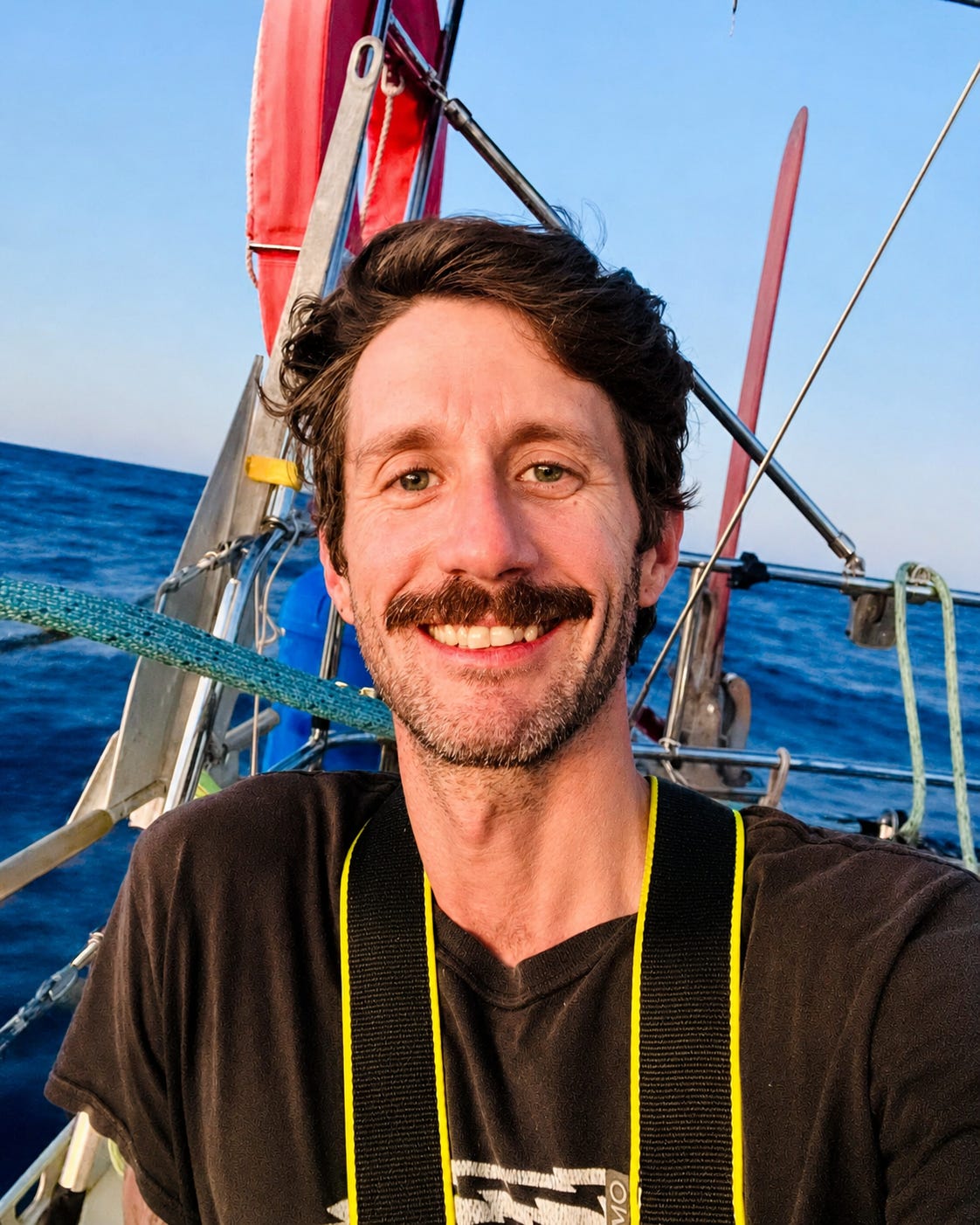
Most people who redesign their lives do it quietly, then write about it years later with all the rough edges smoothed down.
Cory Gerlach is doing it differently. He left a senior federal science career, rebuilt a dilapidated sailboat by hand with his husband, and set off to cross oceans with almost no sailing experience. He's been documenting it all in real time — the doubt, the hard-earned lessons, the clarity that comes from choosing your challenges instead of having them handed to you.
Eighteen years sober, Cory brings a perspective on intentional living and creative work that's grounded in lived experience, not theory.
This week on Clear Conversations, we're talking about what radical transitions actually look like, what sobriety has made possible in his life, and what it means to build something meaningful when the outcome is still unknown.

🎉 What I’m Celebrating
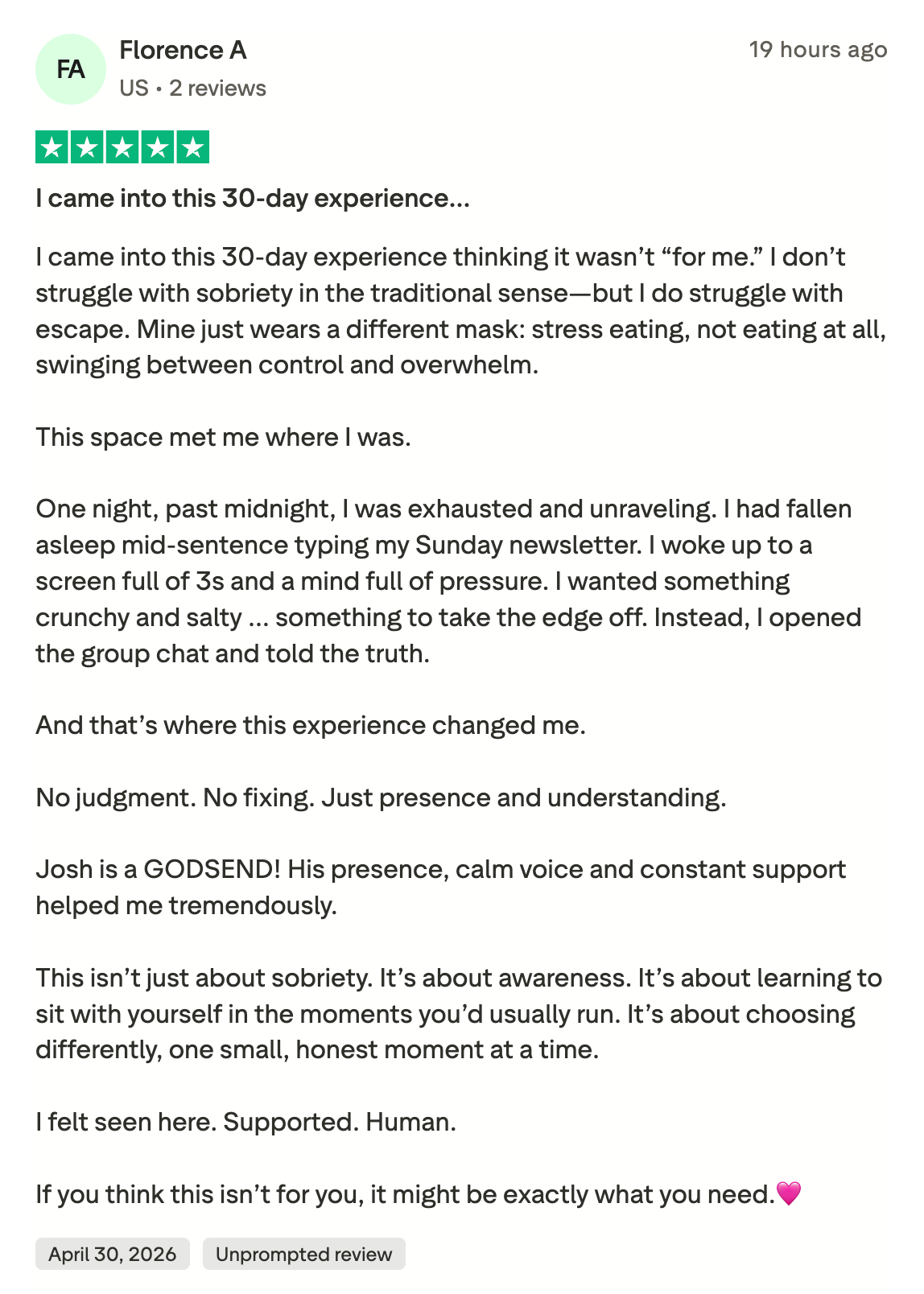
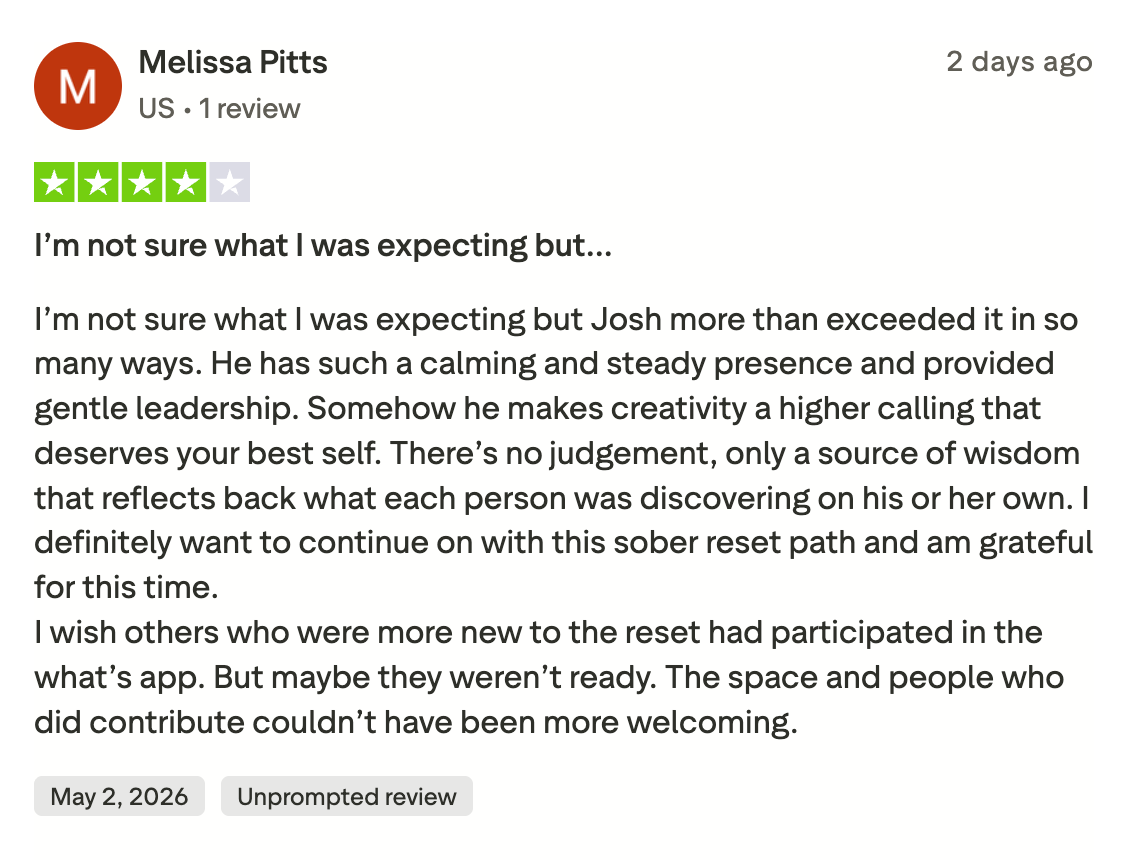
The first of May marked the completion of the April Reset. What I love about doing the Sober Creative Reset is each person’s journey is so unique. All of our paths are different, yet we are all trying to achieve a similar goal, how to find more peace and harmony in our lives.
What I believe is so important with these resets is not so much the structure, while that is important, is community. It’s having another person who is there with you, who see’s you, who knows what you are experiencing and can provide support along the way.
This work is hard. It’s very hard. And it’s quite easy to be hard on ourselves. The work becomes a process of letting that go, of shifting that mindset, of becoming more aware.
I don’t have a date in mind yet for the next one, but you’ll be sure to find out when that date is set.
I’m very proud of everyone who showed up this month. Celebrating you all.
Here are some recent reviews from Trustpilot that I’m celebrating as well.
If you are ready to shift your relationship with drinking, here’s how you can work with me.
Alcohol doesn't have to be the obvious problem to be the real one. Sometimes it's just the thing that makes incomplete recovery feel normal. The Sober Creative Method™ is 90 days, 1:1, built around restoring what alcohol has been quietly taking — your energy, your clarity, your creative capacity. Not willpower. Not labels. Just your system recalibrating.
If you have shifted your relationship with drinking and you want to be a part of a growing community, here’s how you can do that.
The hard part is behind you. What comes next is the work — the real creative work — and it goes better when you're not doing it alone. The Sober Creative Collective is where people on this path come to create, be witnessed, and build something that couldn't have existed before.