


✨Weekly Insight
For years, I reached for something outside myself to quiet the voice that said I wasn’t enough.
The drink didn’t silence it. It just turned down the volume long enough to forget the track was still playing.
Sobriety didn’t make the voice disappear either. But it gave me something the drink never could — the ability to actually hear what’s underneath it.
And underneath it? Something older than the doubt. Something that was there before anyone told me I had to earn my place here.
That’s what I keep coming back to. Not that I’ve made it. Not that I’ve figured it all out.
But that I always was enough — and the work now is just remembering.
🎙️Clear Conversations: Creative Minds in Sobriety
This week I sat down with Florence Acosta — nurse, healthcare executive, stroke survivor, and the voice behind Becoming You — whose story is really about what happens when the life you built around being the strong one gets taken from you all at once.
Florence spent nearly three decades in healthcare, eventually running a surgical center as executive director. Before that she was a certified registered nurse anesthetist — the person who brings someone to the edge of consciousness and is responsible for bringing them back. She held people’s lives in her hands as a professional routine. And by her own admission, she put herself last for most of it. That’s just what you do when you’re the one everyone leans on.
She came into her marriage already knowing what addiction looked like from the outside. Her former father-in-law was an alcoholic, and Florence — a trained nurse who could care for patients in four-point restraints at work — watched his family slowly stop trying. Not because they didn’t love him. Because they’d been trying for so long, and he was never open to receiving it, and eventually the silence just became the pattern. She gave me the sharpest image of this: the man walking out of his grandson’s first birthday party in the middle of summer, jacket pockets stuffed with beer cans. A room full of people who saw it and said nothing. Nobody wanted to cause a scene. So it went under the rug. And then more things did. And that habit of silence bled into her marriage until it ended it.
Somewhere in there — this was 2019, before the stroke — Florence joined a women’s circle. Nineteen women, meeting weekly for nine months. There was a talking basket that went around the room. Florence was always the last to speak. She’d spent so long not asking for what she needed that even naming it out loud felt like too much. That circle is where she first internalized that she mattered too.
Then, at 50, she had a massive hemorrhagic stroke — a ruptured arteriovenous malformation she was likely born with and never knew about. It took her ability to drive. It took her career. It stripped the identity she had spent decades building around competence and holding everything together for everyone else.
Here’s what got me about Florence: she’s not someone who talks about sobriety in the traditional sense. Her relationship to alcohol is through proximity — witnessing what it does to families, to communication, to the invisible architecture of a household. She knows the cost of silence around it. She knows what it looks like when people decide it’s easier to not say the thing. And she spent a long time being one of those people, too — until she couldn’t anymore.
When she came back from the stroke, she started writing. We talked about that for a while — what it means to create something when the professional identity is gone, when you can no longer define yourself by the role. She’s building a business now with her sister. She’s learning, at this stage of life, that you can go faster alone but you go farther together.
There was a moment mid-conversation where her story about the jacket pockets brought up something for me about my own brother, and I had a moment on air. Florence just sat with it. That’s probably the thing I’ll remember most — that she creates space for exactly the kind of honesty she spent most of her life not being allowed to have.
You can listen on Spotify and Apple Podcasts as well.
My Next Guest on🎙️Clear Conversations
Episode 044 with Phil Powis ❤️⚡️ on March 11 at 9:30a EST
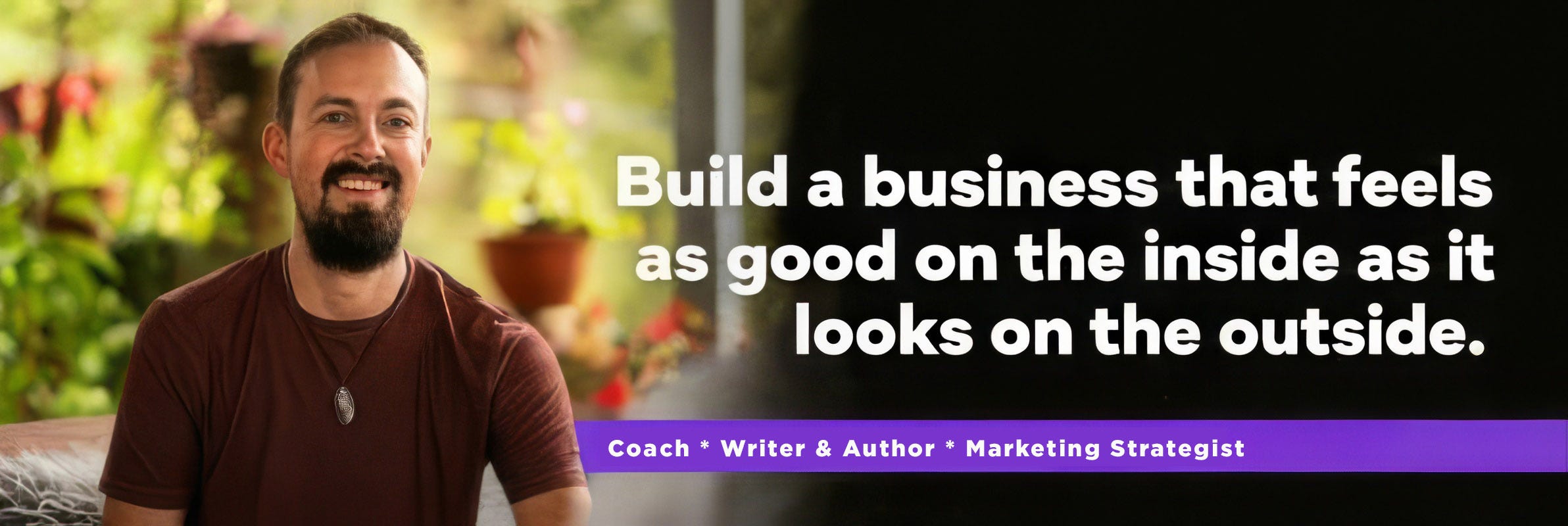
What does it look like when your business stops working against you — and starts working with you?
This week I’m sitting down with Phil Powis ❤️⚡️, co-founder of Sacred Business Flow, a strategist who spent years building what looked like success from the outside while quietly falling apart on the inside. His business was generating over $100K a month. He was also burning out, dealing with a string of health issues, and eventually facing a cancer scare that stopped everything.
What came out of that reckoning wasn’t a new strategy. It was a completely different understanding of what was blocking him — and why strategy alone never quite fixes it.
Phil also brings a perspective I don’t get to explore very often on this show. He’s not in recovery. Alcohol was off the table during his health crisis out of necessity — and when he got his health back, choosing to drink again felt like reclaiming agency. Like freedom. But lately he’s been sitting with a different question: who is the version of him that chooses not to drink from a place of power, not because he has to, but because he’s curious about what that opens up?
He joined the Sober Creative Reset in January and came away not with an abstinence commitment, but with something more valuable — real clarity about when and why he reaches for a drink, and how he wants to approach it going forward.
That kind of conscious, non-judgmental exploration is exactly what this community is built for.
This one’s going to be a good conversation.

🎉 Who I’m Celebrating
You already know what it’s like to give something up and find more of yourself on the other side. That’s the whole premise behind the Sober Creative.
The world of AI is moving faster than we can keep up with. Dr Sam Illingworth isn’t telling people to avoid AI. He’s asking a harder question: what are you quietly giving away when you use it without thinking? For creative people especially, that question matters. The tools that promise to make your work easier have a way of also making it less yours — if you let them.
Sam is one of the few voices in this space who treats your judgment as the thing worth protecting, not the obstacle to be removed. His newsletter, read by over 10,000 people, is built around intentional use — knowing when to reach for the tool and when to stay with the discomfort a little longer, because that’s where your actual work lives.
He’s also just launched something worth knowing about: the Slow AI Curriculum, a 12-month program that just earned formal CPD accreditation — 25 professional development credits, internationally recognized, and tax-deductible as a professional expense. The price goes up to £100/year this Sunday to reflect that.
Sam was also a guest on Clear Conversations and you can view our conversation here.
Episode 035 - The Space Between: Sam Illingworth on Becoming Fearless with 18 Years of Clear-Minded Living

December 22, 2007. Sam Illingworth woke up in a hospital bed with his heart racing, his memory blank, and a doctor offering him the simplest advice he'd ever received: "Don't drink for a month and see what happens." That month became 18 years. That choice became the foundation for a career built not on speed or performance, but on attention, dialogue, and the courage …
For anyone building a creative practice that’s genuinely theirs — one that doesn’t outsource the hard parts — this is the kind of thinking that belongs in your corner.
☀️ What’s Next

Something new is open.
I’ve been sitting with this one for a while — longer than most things I write. Because what I was trying to name isn’t easy to name.
It’s that specific feeling of choosing clarity and then standing in it, wondering what the hell to do next. Not the crisis. Not the beginning. The after.
That’s the part that doesn’t get talked about enough.
What happens when the hardest part is behind you — and you look around and realize the work of becoming is just getting started?
I launched something this week that tries to answer it.
Not a program. Not a course. Not coaching.
Something I think is rarer than all of those.
There’s a quote inside from someone who’s been on this path for forty years that stopped me cold when I read it. She said something about community that I hadn’t found a way to put into words yet — and then she just did.
If you’ve found yourself on the other side of what you were using to escape and thought now what — this is worth a read.
Not because I’m a big part of your article, your words are inspiring. And I’m inspired in so many ways. Especially to watch your episode with Phil Powis!