


✨Weekly Insight
“Welcome to the Sober Creative Restaurant…let me tell you about some of our specials…”
“I would like a tall glass of—no, let me stop you there, we don’t serve that here.”
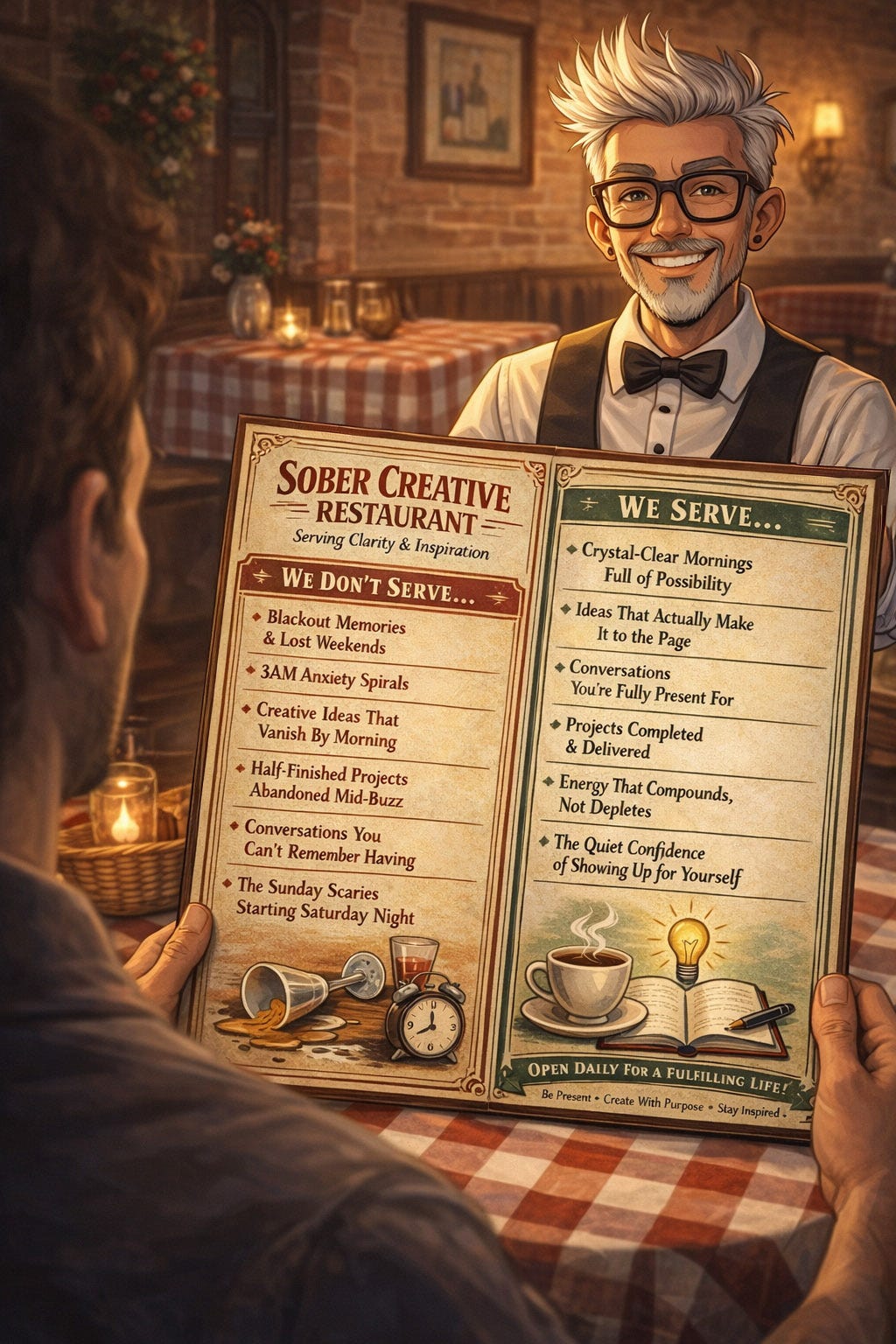
“….those are some of our specials this evening, oh! And people really love the martini meatballs, yes. They are served in a martini glass.”
*sidenote—this is true. I did eat this in a restaurant once.
🎙️Clear Conversations: Creative Minds in Sobriety
This past week, I was fortunate enough to sit down with two guests.
The first was Inge van de Graaf, a trauma therapist and medicine woman who lives above a bar. Not near one. Above one. The ground floor of her home is De Amer, a cultural café and music venue with a fully stocked bar, velvet curtains, and decades of history. She walks past shelves of liquor every single day.
Inge spent most of her life terrified of being seen. She named her practice after a tree because it felt safer than using her own name. She called herself a “regression therapist” because it was explainable, professional, contained. But the work she actually does goes far deeper—guiding people across thresholds from conscious problems to unconscious origins, from who they think they should be to who they actually are.
At 14, she bought herself a bottle of sherry. She thought it was disgusting but drank it anyway. Over time, drinking became her way of coping with the uneasiness of not living the life she was meant to live. She was married, had two kids, took care of everything, kept telling herself “this is the life I choose.” But it wasn’t.
Nine and a half years ago, she was diagnosed with a throat tumor. The oncologist asked: Do you smoke? No. Do you drink? “Oh, well, you know, the odd glass.” A complete lie. She had a bottle of whiskey always ready. She’d function—go to work, take care of the kids—but that bottle would be sitting there waiting when she came home.
Here’s what she realized: when things show up in the throat, it has to do with expressing oneself. She wasn’t expressing herself. She was keeping everything just below the throat. She wouldn’t speak up. She wouldn’t say what she really wanted. She was making herself small. Drinking was how she coped with that.
A year ago, she changed her business name to Praktijk van Inge. Started calling herself medicine woman, gatekeeper, guide. The fear of rejection that she calls her life theme showed up louder than ever. But she did it anyway.
This past month during the Reset experience, both she and her partner decided: no alcohol on their upcoming vacation. Previous holidays always meant bottles of whiskey, bottles of wine. This time they looked at each other and said, “what are we going to do?” Both answered: uh-uh. We’ll leave them in the store.
Inge’s work reminds us: the things we avoid saying, the parts of ourselves we keep hidden, the lives we’re not living—these show up in our bodies. Drinking helps us avoid feeling that discomfort. But the only way through is to finally let yourself be seen. Not as a polished professional. As a person doing the actual work.
You can listen on Spotify and Apple Podcasts as well:
The second guest was Elif Ahmad, a classical pianist and sound healer who quit cocaine without detox, without rehab, without 12-step meetings. She walked away on her own terms and never looked back.
At 17, after performing her honors recital, Elif’s mother decided she didn’t want her anymore. Put her into the streets. Never really spoke with her again. That loss led Elif to believe she had lost all hope. At 28, addiction became almost a suicide thing. She was heavily into cocaine, which turned to crack. She’d function—go to work, handle her responsibilities—but she was using to numb how desperate everything felt.
During active addiction, Elif started watching Sylvia Brown, a psychic on Montel Williams. She’d think: “How does she do that? I want to do that.” So she started reading Sylvia’s books, exploring that world.
She was in the shower one night and felt the walls closing in. She had to make a decision: continue on the path she’d been on, or open herself to transformation and healing. Born into a non-Orthodox Muslim household, she said: “Jesus, I need your help.” In that moment, she felt his presence wrap around her like a blanket of warmth. From that moment, everything changed.
Here’s what Elif teaches: recovery doesn’t have one path. The traditional system tells us there’s only one way—meetings, steps, sponsors, labels. But healing can come through prayer, through energy work, through spiritual connection. She became a Reiki master teacher, helping people move away from labeling themselves as addicts and toward understanding addiction as an experience—one that doesn’t have to define who they are.
Elif’s story reminds us: when we were little, we fell down and got back up. Where in our lives did we stop being like that? Where did we start taking everything so seriously instead of just dusting ourselves off? Children are still deeply connected to themselves and to the non-physical world. Can we go back to that? Can we remember that there’s more support than we see with our physical eyes?
The non-traditional path saved her life.
You can listen on Spotify and Apple Podcasts as well:
My Next Guest on🎙️Clear Conversations
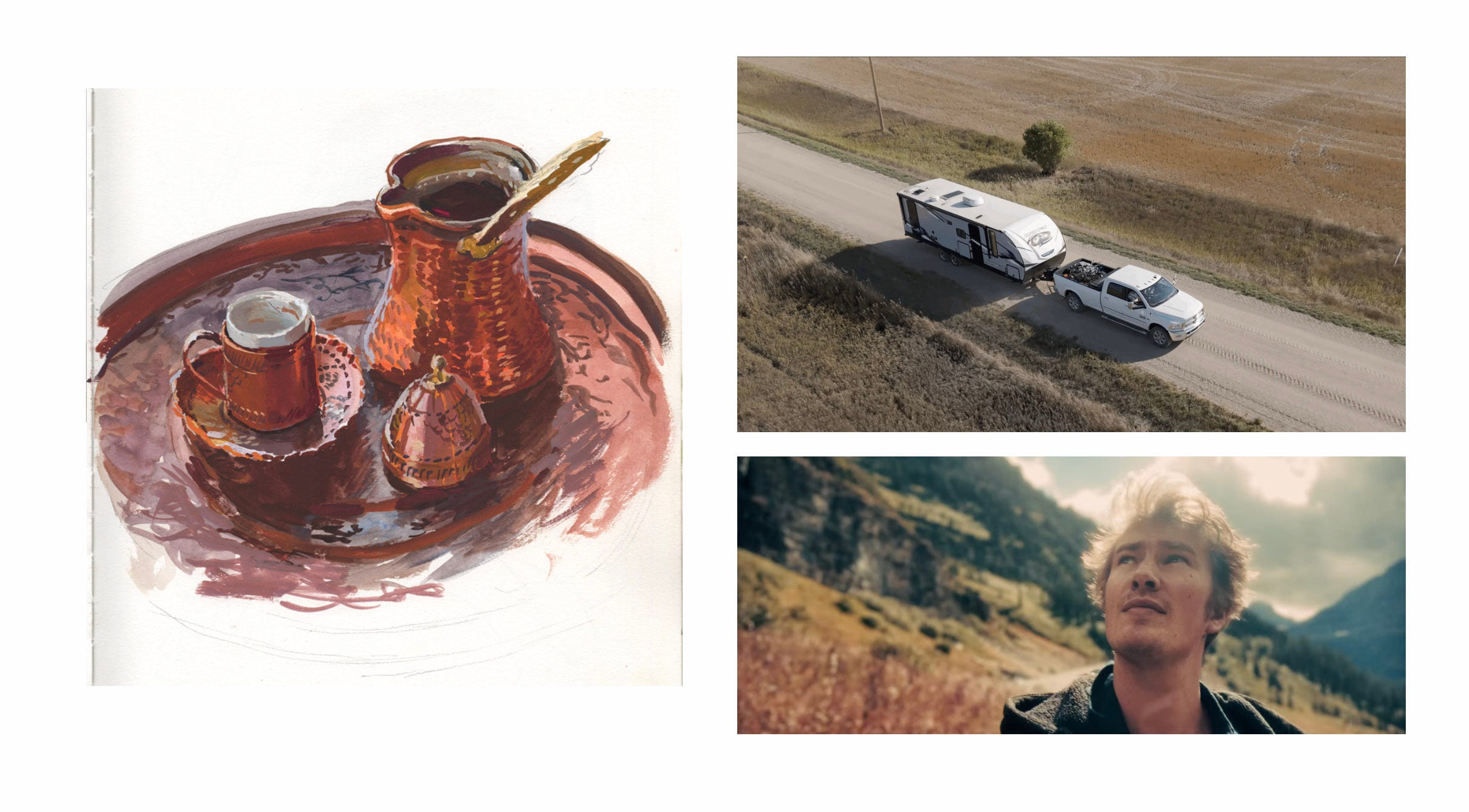
Episode 040 with Justin Donaldson on February 12 at 3p EST
What happens when an artist realizes the tools meant to help are actually slowing him down? Justin Donaldson traded digital precision for gouache and watercolor—not for nostalgia, but because traditional painting forced him to stop outsourcing his instincts to the machine.
He discovered that commitment breeds clarity, that time constraints pull you out of your head and into your gut, and that sometimes progress means letting go of what doesn't work. Now painting full-time from a camper while traveling the U.S., Justin's work captures landscapes in single sittings—one shot, one chance.
This week, we're talking about deep listening, his nuanced relationship with substances—overcoming PTSD through therapeutic mushroom use, why he doesn't drink (it makes his body feel like trash), and how he found peace without needing anything.
It's a conversation about living at peace with your mind and body, and what becomes possible when you trust your instincts.
🎬 Behind the Scenes

The next Sober Creative Reset is being created!
I questioned whether or not to keep these resets the same because if it worked so well the first time, why change it for the others?
The format will be similar, but as you know, being creative is a big part of the process. My soul comes alive when I create and so the inspiration behind these resets will be “seasons.”
All of the email prompts will have new illustrations to go along with each theme.
Every reset will be it’s own experience.
This was a quote from Inge in the January Reset:
“His most important tip for me: see each time as a choice, don't make it about "never drinking again for the rest of my life". That nuance unlocked something in me. For the first time since I've been doing resets, I'm seriously considering choosing non-alcoholic on a structural basis. That wasn't an option before, now I find it very attractive.”
It will start on April 1st and more details will be available soon. If you want to be notified, click the link below and you’ll be put on the list.
Wow Josh! The writing, the guests, the podcasts and Lives, and now The Reset. You are very creative and ambitious! I admire your work. Cheering you on!🩷