


✨Weekly Insight
Life will always present challenges. Some days will be really hard to get through. You’ll question whether or not you’re doing things right. The word “why” will replay over and over.
Yet, the solution isn’t to escape with a drink. It’s to acknowledge that this is part of the experience, give yourself compassion and ask: How can I become more aware of what I need in this moment?
Insight emerges from that awareness.
🧘Guided Meditations
One Minute Breathing Reset
A practice for preventing the evening spiral
Cravings don’t hit by the time you are walking out of the store with a 6-pack.
They start waking up in the morning wondering if you will drink today. Midday dealing with traffic or conflict with someone else. At the end of the day when you’re running on fumes but pushing through anyway.
When you crack open the bottle, what you’re really craving is relief from a nervous system that’s been in overdrive all day. Or even deeper is an unmet need you don’t know how to process yet.
For years, alcohol was how I dealt with accumulated stress and depression. The easiest solution at the time was to drink until things “settled.” This was me trying to shut off a system I didn’t know how to regulate.
Getting sober was challenging because I had to stick through the cravings. And at times, that was really intense. The tool that was always there working in the background, but I never fully grasped its power was breathing.
This one-minute breathing reset is a tool to add to your basket. Use it as many times as you need. One minute, multiple times a day, adds up to a completely different evening.
The craving you prevent is the one you never have to fight.

💡Disrupt the Pattern
The room feels effortless for nearly everyone else. You feel like you’re working overtime just to appear relaxed.
A thought surfaces: “I don’t belong here like this. I need something to loosen me up.”
Alcohol promises connection. But it actually removes your access to the one thing that creates real connection: presence.
This episode breaks down the performance trap—and what becomes possible when you stop managing perception and start trusting that you’re already enough.
🎙️Clear Conversations: Creative Minds in Sobriety
This past week, I sat down with Paul Overton, facilitator of The Men’s Circle, who quit drinking 30 years ago—though he’ll tell you he doesn’t keep close track anymore. Growing up in 1970s California as a Gen X kid left to his own devices, Paul started drinking at 12 or 13. His family normalized alcohol. Nobody was angry or out of control, but “everybody was definitely half in the bag most of the time once it got to past two in the afternoon.”
For years, Paul worked as a dance teacher traveling the world. He always felt a hole inside that he tried to fill with substances, sex, and other addictive patterns. Eventually, he recognized the problem and told his partner he needed to stop.
But removing alcohol was just the beginning.
Paul describes trauma as an onion that needs peeling. On the outside: behaviors. The next layer in: unmet needs. Deeper still: wounds. At the core: attachment issues. “I had to figure out what my unmet needs were that were causing those behaviors on the outside,” he told me. Understanding this took years of slowly peeling back layers.
Here’s what most people don’t understand: the nervous system governs everything about how we show up. We medicate our nervous system states with substances. Alcohol shifts you from sympathetic to dorsal. The body becomes dependent on substances to shift states rather than learning to do it naturally.
Seven months ago, Paul started The Men’s Circle. It meets twice weekly—once online, once in-person for walks. On Sunday walks, they hug in greeting. Paul set this tradition wordlessly because he knew he needed practice and the other men did too. At first, the hugs were stiff. Men leaned in with shoulders but kept hips back. But over time, the hugs became easier. Breathing slowed. Shoulders dropped. Something in the body learned it didn’t need to defend itself.
“A lot of men aren’t closed off by nature,” Paul said. “They’re just well-trained.”
Sobriety doesn’t just remove the substance. It reveals what’s underneath—the unmet needs, the wounds, the parts of ourselves we never learned to regulate. Paul’s work reminds us that most men don’t need fixing. They need to be less alone, more regulated, and more connected over time. Through consistency. Through learning what their nervous system is actually doing. Through touch that tells the body it’s safe.
You can listen on Spotify and Apple Podcasts as well:
My Next Guest on🎙️Clear Conversations
Episode 037 with Georgia Kohlhoff on January 29th at TBD
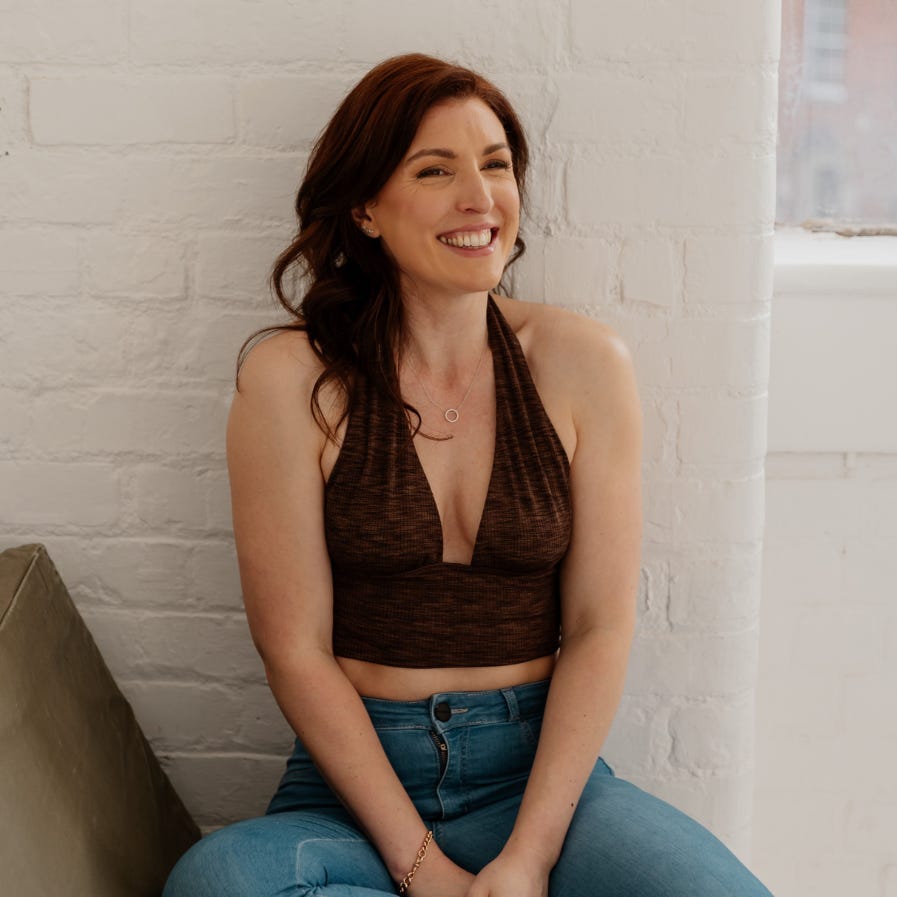
This week I'm sitting down with Georgia Kohlhoff — a Registered Nutritionist and trainee therapist who spent two decades knowing exactly what to eat but couldn't stick to it.
Georgia works with high-achieving women to bridge the gap between knowing and doing, especially around midlife, PCOS, and the mental loops that make food choices feel impossible.
What does this have to do with sobriety? Everything. Because the same patterns that keep you negotiating with the biscuit tin at 4pm are often the ones that keep you reaching for wine at 8pm.
As Georgia writes, she knew that drinking less alcohol would help—she could have passed a nutrition exam on it—but knowing what to do and being able to do it are two completely different skills.
If you've ever wondered why willpower fails you, or why "just be kind to yourself" hasn't solved anything, this conversation will reframe everything you thought you knew about discipline, structure, and what it actually means to have your own back.

🎬 Behind the Scenes
This new format I’m working with the Disrupt The Pattern series has me working multiple days in a row in order to prepare. The topic is researched. The written format placed and revised. Then it’s a process of memorizing because I don’t want to use a teleprompter. It’s challenging and I appreciate that it is.
Here’s a short few clips I put together that hopefully will have you laughing as I did.
What becomes visible when you slow down enough to see it?
The practices. The patterns. The path forward that's been there all along.
If you're ready to explore what 1:1 coaching could unlock, book a free clarity session.
No pitch. Just an honest conversation about where you are and where you want to go.
P.S. You can view past newsletter editions here.
I'm really looking forward to this!