


✨Weekly Insight
Joy isn't standing in front of you when the fog clears.
It's the path that opens — leading to the work.
The morning routine you actually keep. The creative project you show up for even when it feels flat. The moment of gratitude you pause long enough to actually feel.
The gap between removing alcohol and experiencing genuine contentment is where most people get stuck — because our brains aren’t wired to notice the good we’re building. We dismiss the small wins, rush past the quiet victories, and wonder why sobriety still feels empty.
The practices matter. But only if we’re paying attention long enough for them to change us. Maybe it’s a really good thing to give ourselves permission to slow down.
🎙️Clear Conversations: Creative Minds in Sobriety
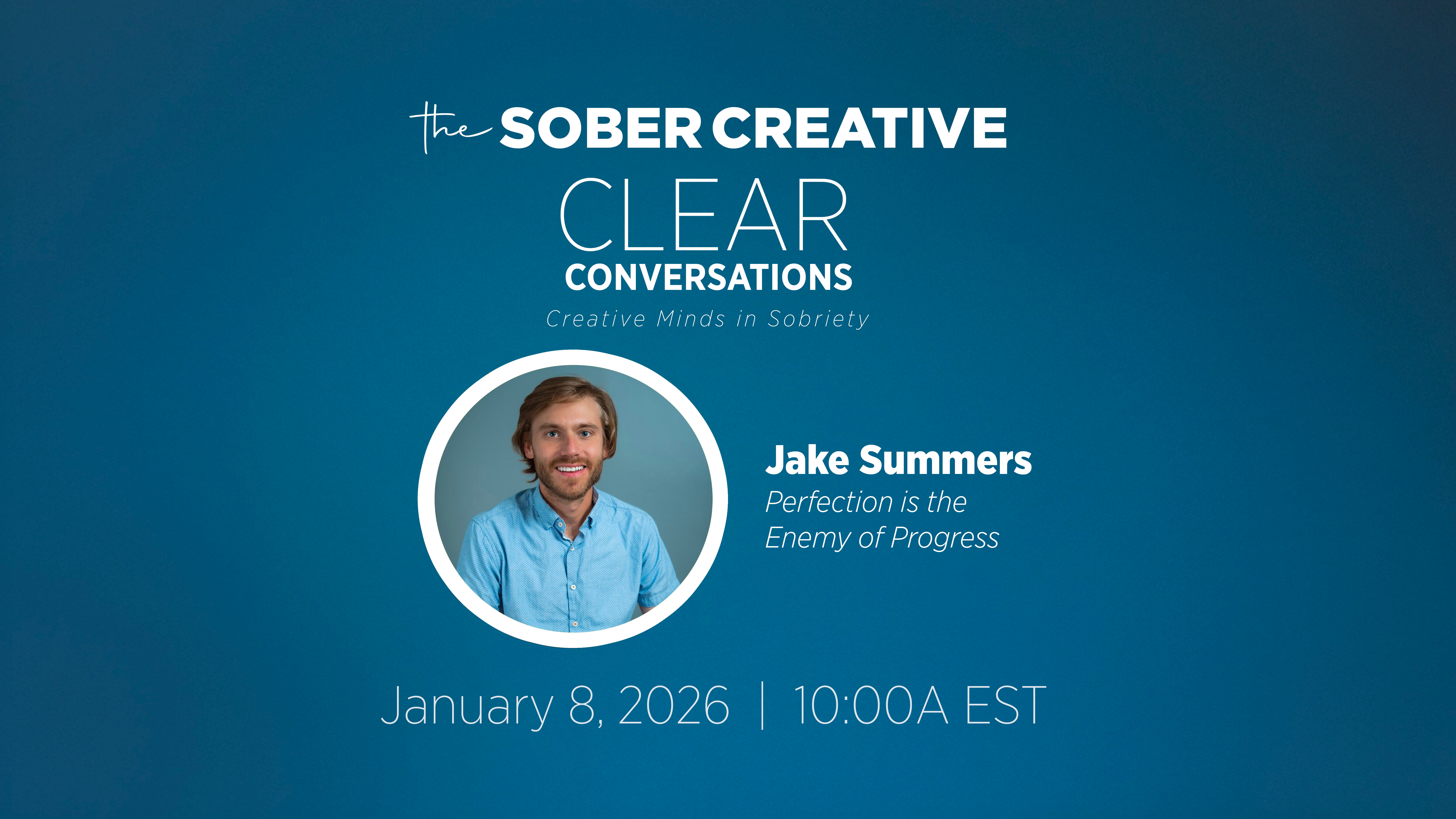
This past week, I sat down with Jake Summers, creator of “Perfection is the Enemy of Progress,” who got sober on December 4th, 2019—after relapsing in Cambodia following four years of recovery. In his early twenties, he was drinking a fifth a day, sneaking to the liquor store at 9 AM, drinking flask bottles in the bathroom at his finance job.
Jake spent years caught in the guilt-fear-shame cycle: wake up telling himself he wouldn’t drink today, drink anyway, feel intense shame, wake up the next morning scared it would never resolve itself. There was this quiet voice saying “this is dumb, this is going to head towards disaster”—constantly drowned out by an extreme voice saying “I need this right now. I need my relief.”
After getting sober, he felt confident enough to start a mango farm in Cambodia. Four years sober, everything was going well. Then he relapsed during a ritual toast with fermented banana moonshine. He’d drifted away from his recovery. Wasn’t talking to sober people. Thought he was cured. His mom had to come rescue him.
When he came home and started over, he didn’t keep recovery siloed from the rest of his life. He built his entire life around his recovery this time.
Here’s what he discovered:
“In my first stint in recovery, it was very siloed. I had this career and these aspirations and this adventurous side. And then I had my recovery. And I let enough distance get between those two lives that I put myself in a risky position again.”
Now Jake wakes at 4:30 AM for a sacred two-hour creative block. He lights a candle, makes coffee, writes in his basement. If he sticks the landing in that morning block, the rest of his day is playing with house money. He’s working on his memoir The Mango Tango and building a life with enough white space for opportunities to come to him.
Sobriety doesn’t just give you back your mornings. It gives you the ability to build a life where recovery isn’t separate from who you are everywhere else—so the practices that sustain you don’t fade into dangerous gaps where relapse finds room to grow.
You can listen on Spotify and Apple Podcasts as well:
My Next Guest on🎙️Clear Conversations
Episode 035 with Sam Illingworth on January 15th at 9:00a EST

This week I'm sitting down with Sam Illingworth —a poet, professor, and the creator of Slow AI.
Sam's work challenges the speed trap most of us fall into with technology, using poetry, games, and AI as tools for deeper reflection rather than faster output.
Eighteen years ago, Sam made a choice that changed everything: he quit drinking. That decision didn't just clear the fog—it opened up a different kind of creative practice, one built on care, attention, and the courage to move slowly in a world obsessed with acceleration.
We'll talk about what sobriety unlocked in his work, how he teaches creative thinking in ways that honor complexity instead of flattening it, and why slowing down might be the most radical thing a creative can do right now.
🎬 Behind the Scenes
Yesterday was the first event of Social Sober Club, a local meetup group I started in order to build community here in the Raleigh, NC area.
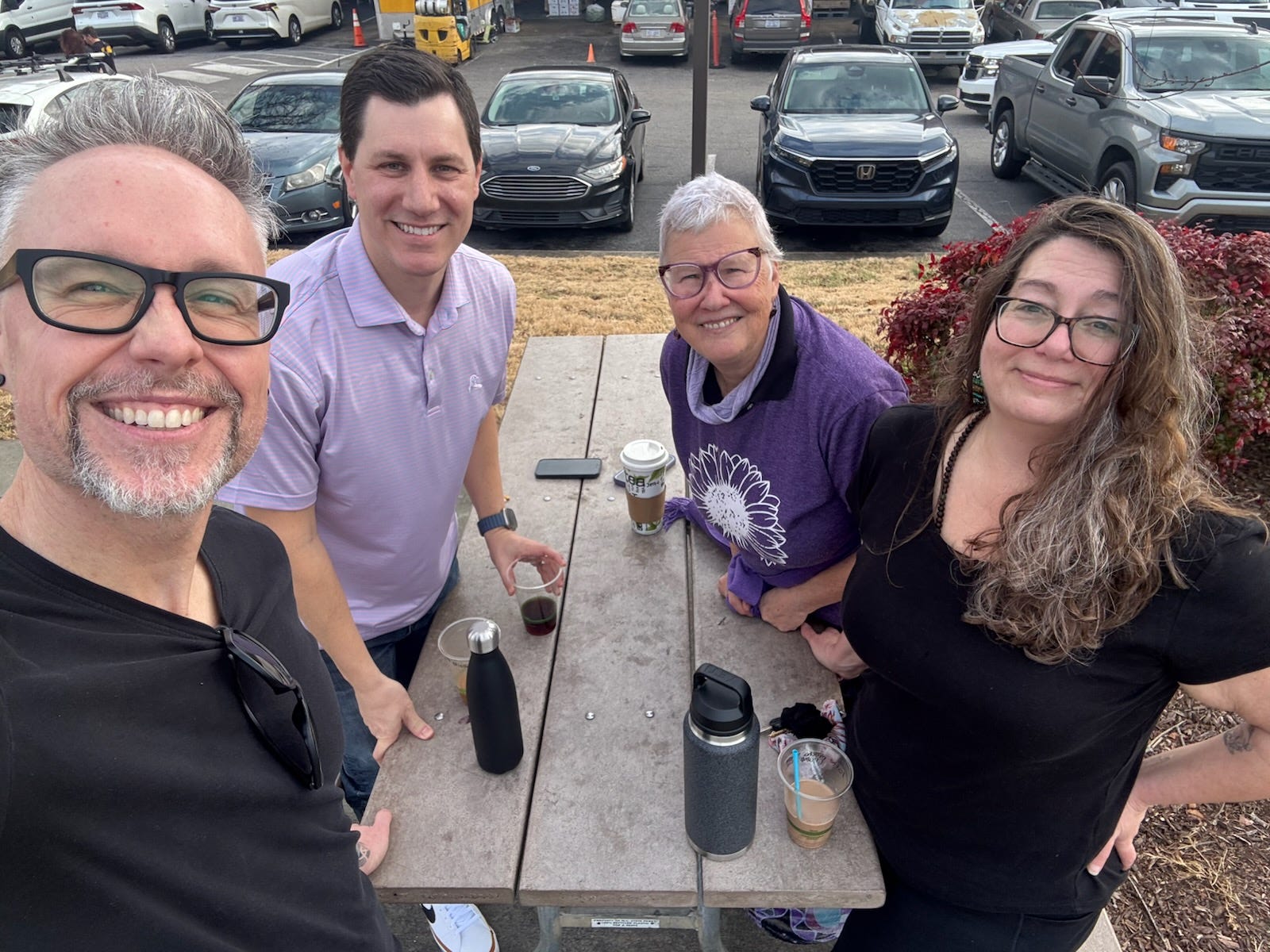
Our first event was at 321 Coffee in the farmers’ market location.
321 Coffee is a coffee shop and roaster built on inclusion. 321 currently employs over 50 adults with intellectual and developmental disabilities (IDD). They are the ones roasting the coffee, taking the orders, and making the lattes. They are demonstrating the value of an inclusive business model.
Since there were 4 of us, I broke us up into pairs, set my timer for 20 minutes. Once that was done, I rotated with each person, and we were all able to spend time with each other.
The plan as of now is to do 2 meetings a month, where there will be this coffee + conversation at a different local spot, and the other one will be activity-based: local nonprofit, square dancing, video games, lots of options!
I’m looking forward to building this further and giving people more options to connect without having to feel that alcohol needs to be involved.
📖 What I’m Reading
This week, I started Hardwiring Happiness by Rick Hanson, Ph.D. - a neuroscience-based self-help book that teaches how to rewire your brain for greater well-being, resilience, and happiness.
The core premise is that our brains have a “negativity bias” — we’re wired to notice and remember negative experiences more than positive ones as an evolutionary survival mechanism. This means positive experiences often pass through our minds like water through a sieve, while negative ones stick like Velcro.
Hanson introduces a four-step process called HEAL to counteract this:
Have a positive experience — Notice or create something good
Enrich it — Stay with the experience for 10-30 seconds, intensify it, feel it in your body
Absorb it — Imagine the experience sinking into you, becoming part of you
Link (optional) — Hold both the positive experience and a negative memory simultaneously, letting the positive soothe the negative
The key insight is that most positive experiences are “wasted” because we don’t take time to install them in our neural structure. By deliberately savoring positive moments and holding them in awareness longer, we literally change our brain’s structure through neuroplasticity.
The book emphasizes that small, everyday positive experiences (a good cup of coffee, a moment of connection, accomplishing something) are the building blocks of lasting happiness — not just major achievements. It’s practical neuroscience applied to daily life, showing how taking an extra 20 seconds to really absorb good moments can gradually shift your baseline emotional state toward greater contentment and resilience.
What I hope to gain is another way I can speak about how science, the mind and the body interact with alcohol, and the HEAL method sounds like rich medicine when it comes to letting go of what doesn’t serve you.
What becomes visible when you slow down enough to see it?
The practices. The patterns. The path forward that's been there all along.
If you're ready to explore what 1:1 coaching could unlock, book a free clarity session.
No pitch. Just an honest conversation about where you are and where you want to go.
And the path is lit with guiding glowy orbs.